Tariku Negasi was not the regular Founder or Business leader. Everything about him was shrouded in mystery and uncertainty. The unconventional educational journey added another layer to his story. There was always that lingering doubt about his true motivation.
On paper, he was driven by the need to create a better world. However, the world has not seen a man whose ambition is not driven by self or profit. It was hard to buy his neatly packaged altruistic story.
The entire Dev seemed too good to be true. To most people, it passed as the solution the world needed. The doubt and suspicion were nothing more than a gut feeling for sceptics. With cancel culture and social media, sharing any opinion against Dev was akin to digital suicide.
In truth, Dev was a paradox of ideologies. A platform that championed transparency and equality was led by a mysterious hegemony. Unlike other organizations, Dev was created by managed by a mysterious team on Earth called the Invaders. However, the transition to Dev and life in the digital universe was run by another group. They seemed more like a secret society. There was no official name for them but they were unofficially known as the System.
Negasi was the supreme leader. He had selected a group of super-intelligent young people to lead the core groups hidden in the shadows of Dev.
There were four major groups in the System.
The Gatekeepers

The first group was called the Gatekeepers. They managed every detail of the transition process, from the physical to the emotional triggers and hormonal composition. Everything was designed and controlled internally before setting up MaDe to ensure certain things were under control on Dev. It was one way they could keep people happy and suppress emotions like sadness, envy, jealousy, etc. They numbed out everything that could fuel a crisis or what we call ‘bad behavior.’ Everyone on Dev was meant to be perfect.
Coming from Earth, Dev did not seem like it needed a gate. The massive campaign for Dev had made it a destination for everyone. People were happy with the fact that they could go and didn’t care much about coming back to Earth. In their defense, Earth was dying. Man had over-exploited the planet and destroyed it for future generations. Every other year people on Earth got a new doomsday marked on calendars. They watched the Sun, moon, and stars, trying to read the end of days. Even though people never got it right, it was almost general consensus that Earth was failing.
While they anticipated that people will throng to Dev, the Gatekeepers knew that absolute control was necessary. This would help the System manage the narrative that got back to Earth. If people were allowed to return, they wouldn’t fit into normal society on Earth with the suppression of key emotions. The Gatekeepers made it as good as impossible to return to Earth. Even among the members of the System, it was pretty difficult to return.
The Hounds

The second group was the Hounds. Negasi had introduced this group as a fail-safe measure for the negative emotion inhibition plan. These people spread across the living area of Dev to monitor the activities of people. They tracked emotional spikes and reported any anomaly for control and extraction. There was no death on Dev, but there were a few disappearances and nobody felt uncomfortable about it.
People had the option of changing their location, physical appearances, and even identity without informing anyone. The Hounds were quite friendly. They checked glitches, bugs and other challenges in realtime. They also joined group discussions, pushing the envelope by leading edgy conversations to test the leanings of certain people. People outside the System didn’t the actual identity of the Hounds. Only Negasi and the Invaders knew all the Hounds. They could disable avatars remotely. It was like giving the Police the power to eliminate potential criminals before they could actually become criminals.
They mapped metadata with triggers and response indicators to predict behavior and acted based on the predictions. Nobody could tell if this was effective. There was no crime on Dev so all the research was done with people on Earth but implemented on Dev.
Hounds really didn’t care about the methodology or outcome of the research. They gladly took the task and carried it out with ruthless efficiency.
The Librarians

The third Group was the Librarians. They maintained the warehouse of stacks and managed knowledge acquisition, sharing, development, and the curation of all living experiences. They also managed research and innovation, to expand the knowledge base on Dev. They were the brains behind all the new possibilities that rolled out each week on the platform.
This group had very few hands. They weren’t bothered about hiring new people as the ones with the experience were not getting older or weaker. They analyzed all stacks that were loaded on Dev and took vital information and experience to enrich themselves with knowledge. As expected, Negasi had a close grip on this group. They held some of the secrets of Dev and kept them within the group.
The Librarians handled all the additional knowledge available to people on Dev. They simply installed new stacks based on demand. They had duplicated everyone’s cognitive knowledge during the transition and stored them as stacks. These could easily be installed for anyone else on Dev. The more people on Dev, the wider and more diverse the stack library got. You could install the experience of a 70-year-old CEO and have the benefit of his experience in his field instantly.
The Architects
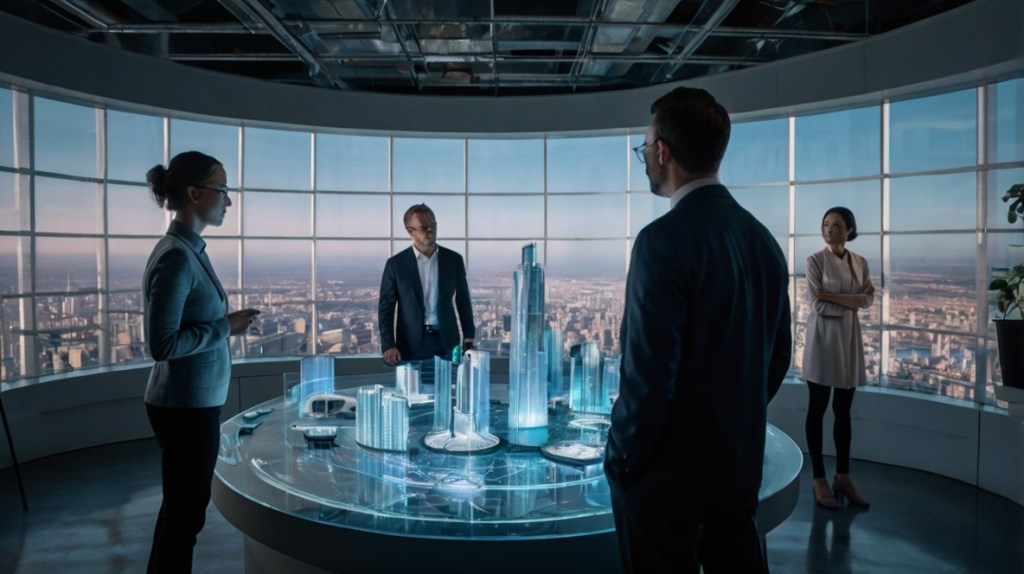
The fourth group was the Architects. Unlike the other groups, the Architects were responsible for the very fabric of Dev itself. They designed and maintained the intricate virtual landscapes, ensuring every aspect of Dev was both functional and aesthetically pleasing. Their work ranged from the towering skyscrapers to the serene artificial forests, creating a perfect environment!
The Architects operated under a philosophy of continuous improvement. They were tasked with not only maintaining but also evolving Dev, integrating the latest technological advancements and innovative designs. This group had a unique combination of skills, blending engineering prowess with artistic creativity. Each Architect was a master of virtual reality, artificial intelligence, and digital art. They were handpicked by Negasi himself for their exceptional talents.
One of the critical responsibilities of the Architects was the seamless integration of new blocks (digital land) and technologies. This involved rigorous testing and meticulous planning to avoid disruptions. They collaborated closely with the Librarians to understand the demands of Dev’s inhabitants and to anticipate future needs.
Security was another paramount concern for the Architects. They were the unseen guardians of Dev’s spatial integrity, continuously monitoring for any signs of tampering or breaches. Their vigilance ensured that the virtual utopia remained free from malicious influences, maintaining the trust of its inhabitants.
The Architects also played a crucial role in user experience. They collected feedback from Dev’s residents, analyzing patterns and preferences to enhance the overall environment. This iterative process allowed them to create spaces that met functional needs and fostered a sense of well-being and community.

Negasi maintained a close relationship with the Architects, often involving himself in their creative processes. His vision for Dev formed the core of their work. He relied on their expertise to bring his ideas to life. Despite their critical role, the Architects operated in relative anonymity. Their identities also remained a secret to those on Earth. Only a select few within the System knew them.
The synergy between the Architects and the other groups was vital to the success of Dev. The Gatekeepers provided the data on human behavior and emotional triggers. The Hounds ensured security and stability. The Librarians curated knowledge and innovation, and the Architects wove all these elements into the thriving digital world of Dev.
In this intricate web of collaboration and control, Tariku Negasi stood at the centre. He orchestrated a symphony of talents and technologies to create what he hoped would be the pinnacle of human achievement.
Yet, beneath the surface of this digital paradise, a dark flame was burning. There was a more complex motive, leaving the true purpose of Dev shrouded in mystery.
 The Time Tale
One Comment Add yours