The Awakening
Kytz was a pure artist and a staunch believer—not in religion, but in the transformative power of words. He believed art could change lives and transform the world. It was this conviction that led him to accept to spearhead the campaign for Dev. He believed it was a digital utopia where humanity would be free from the limitations of life on Earth. Famine, sickness, death, pain, emotional trauma—these would all be eradicated.
Kytz had built his career on creating music that transcended cultural boundaries and spoke to the universal human experience. His music was accepted by people across the world, something Negasi wanted for Dev too. The entire Dev campaign resonated deeply with him. With the slogan “Heaven is a Click Away,” it felt like the natural next step in his artistic evolution.
He passionately threw himself into the project. When the agency mentioned that they would like him to recreate John Lennon’s “Imagine,” it struck a chord in him. He spent some time away from the public eye and returned with what quickly became a global anthem. The project’s launch at the Addis Ababa International Conference and Exhibition Centre was nothing short of breathtaking. Holographic displays, angelic choirs of children, and Kytz’s soulful performance set the tone for all that Dev promised humanity.

Seeds of Doubt
As an artist, Kytz craved interaction with his audience. His art was a conversation, and he sought out feedback to complete the dialogue. After the launch, he became obsessed with online reactions. He scrolled through endless streams of comments, soaking in the praise—but focusing on the criticism.
Amid the applause, a few dissenting voices began to emerge.
“Don’t be fooled by the glitz. Dev is nothing but a digital cage.”
“Negasi’s vision isn’t a utopia; it’s total control.”
“They say ‘Heaven is a Click Away,’ but what happens when they control the clicks?”
At first, Kytz dismissed these comments as the usual chatter from conspiracy theorists. Every groundbreaking project had its critics. Yet the same voices kept resurfacing, weaving a narrative that portrayed Negasi as a modern-day Icarus.
It was only a matter of time before he gave in to the curiosity the messages evoked. One day, a message slipped through his carefully curated inbox. It was from a group calling themselves “The Unplugged.” They claimed to know the inner workings of Dev and the dark truth behind it. They wanted to meet.
The Encounter
Kytz agreed to meet The Unplugged in a nondescript café on the outskirts of Nairobi, far from prying media eyes. When he arrived, he found four interesting people waiting for him. There was an ex-engineer from Dev, a former government official, a journalist, and a scientist who had vanished from public life years ago.
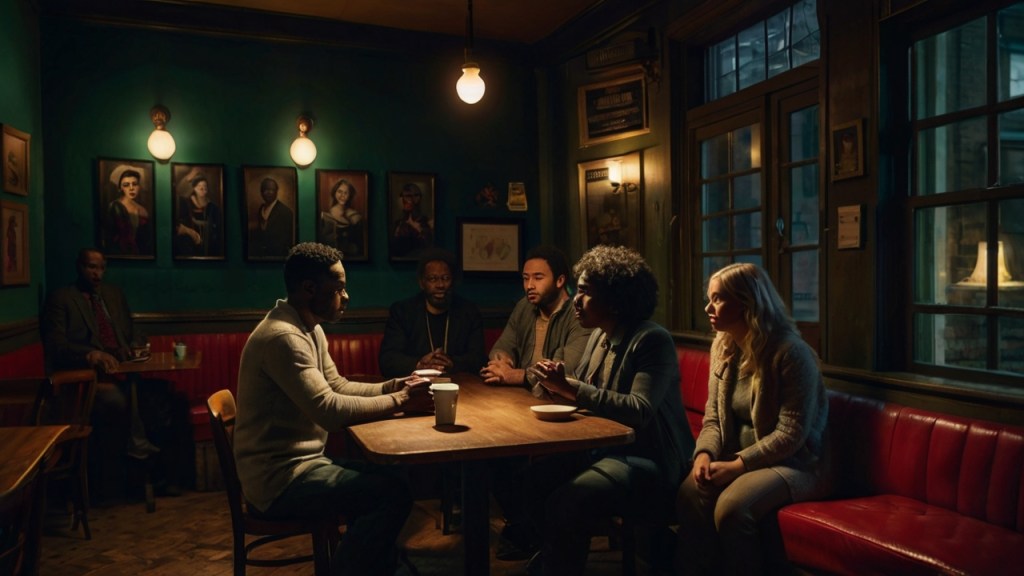
The ex-engineer was the first to speak. “…we admire your work. Your music has always spoken the truth, and that’s why we think you need to know this. We believe you’re a puppet in Negasi’s scheme.”
They laid out their case in meticulous detail. Dev wasn’t just a platform for creativity, they said; it was a tool for control. Every interaction uploaded to Dev was monitored and analysed, shaping everyone’s reality to fit Negasi’s vision. They claimed his vision far less benevolent than the world had been led to believe. They spoke of predictive algorithms that could manipulate users’ decisions before they even realised it. The Unplugged claimed Dev wasn’t just a digital utopia; it was a new form of global mind control.
Kytz listened in stunned silence. The stories were too detailed to dismiss as mere conspiracy theories. The government official revealed how policies were being quietly altered to grant Dev more power. The scientist spoke of hidden behavioural control experiments and all the lives lost during these experiments. The journalist presented some documents that exposed Negasi’s true ambitions. The entire case against Negasi was more of a strong verbal allegation with little or no hard evidence.
As scanty as the evidence seemed, it somehow did the trick. By the end of the meeting, Kytz felt the ground had shifted beneath him. He had helped sell this dream to billions—and now, it seemed that dream was a dark global scheme.
The Reckoning
The following weeks were a blur. Kytz withdrew from public life, just as he had done when preparing for the “Imagine” campaign. This time, he wasn’t creating music. He was hunting for the truth. He scoured documents, interviewed ‘whistleblowers’, and dug into Dev’s history and Negasi’s past. The more he learned, the more horrified he became. The journalist interviewed people who claimed they had been paid to remain silent. Others claimed they were too scared to speak up openly.
During this period, Kytz wrote a new song and leaked it. He called it “Echoes in the Dark,” a haunting melody laced with cryptic lyrics that hinted at Dev’s darker side:
“In a world where dreams are sold,
Who holds the strings? Who calls the fold?
In the shadows, whispers start,
Echoes in the dark, a poisoned heart.”
The song spread like wildfire through underground networks, becoming an anthem for those who questioned Dev’s true purpose. In interviews, Kytz spoke in ambiguous terms, hinting that something was wrong with the utopia he had once championed.
“Utopia is a dangerous word,” he said in one interview. “It implies perfection—but who decides what perfect is?”
In another, he remarked, “The lines between dreams and nightmares are often blurred. It’s important to remember that.”
Fans and the media picked up on the shift in his tone, but the ambiguity left everyone guessing. All indications that he was referring to Dev passed as more conspiracy theories. It was left for people to decide what they wanted.
The Farewell
As Kytz prepared for his world tour, he announced a new project: “Off the Record,” a series of intimate, device-free conversations with his audience. “It’s time we talked,” he said in a promotional video. “Really talked.”
The first event, held in a small Berlin theatre, was extraordinary. Kytz spoke candidly, sharing his concerns about the direction the world was heading. He didn’t mention Negasi or Dev by name, but his words left little doubt about who he was referring to. The audience was spellbound. But with the event designed to keep recording devices out, everything was passed through word of mouth. He wanted to have these events in multiple cities across the world, and Berlin was just the first.
Then, just as quickly as the event ended, Kytz vanished. He missed his next show, and his team had no explanation. The media went into a frenzy. Theories about his disappearance ranged from kidnapping to self-imposed exile. Some believed he had been silenced. Others speculated that Negasi had orchestrated his disappearance.
The Legacy
In the months that followed, Kytz’s music became anthems of resistance. “Echoes in the Dark” was dissected, its cryptic lyrics seen as warnings of unchecked power. The title “Off the Record” became a rallying cry for those seeking truth in an increasingly controlled world.
As for Kytz, his fate remained a mystery. Some believed he had been silenced. Others thought he had chosen to disappear, a martyr for the cause. Yet no matter where he was, one thing was certain—his message had struck a chord. As long as his music played, the echoes of his words would resonate, urging humanity to seek the truth, no matter how dark.
 The Time Tale