I came to Dev with excitement. For me, it wasn’t an escape from hardship on Earth because I actually had a great life there. Most of the people I’ve met here had one reason or another to come, but mine was mainly curiosity. Dev was an intriguing prospect for me and my friends. It was also meant to be a way to run from the shadow of my parents.
My dad was a politician in Nigeria. We were rich—for a Nigerian family. You can only imagine the things I was exposed to at an early age. I had travelled to more countries than the number of years I had spent on Earth. For a Nigerian, that’s a flex. After about 16 years holding different political offices, my dad decided to ‘retire’. His retirement made us see how much money we were spending and how fast one can blow through money that’s not tied to any enterprise. I decided to explore Dev before the money ran thin.
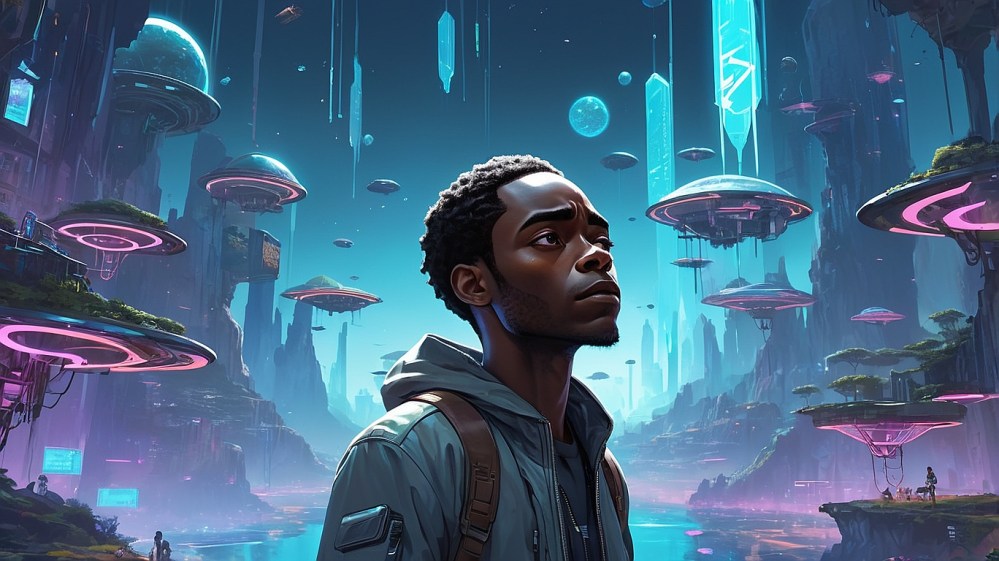
My experience on Dev has been an eye-opener. It has shown me what it really means to be human. It’s not in the things on Dev, but in the things I left behind on Earth. Some years ago, I would have trolled anyone who made statements like that. Today, I see the sense in all the things my dad used to say. He often spoke of the beauty of struggle. He would say, “It’s the tension between what we want and what we can have that keeps us alive.” He was always against the idea of Dev. “Perfection is death in disguise,” he told me once, his voice heavy with both love and resignation. I called his decision ‘old school’ and laughed it off. Our last argument (we did fight a lot) keeps playing in my mind.
“Perfection is death in disguise,”
– Takim Otu Snr.
“I just want you to live a life that means something,” he said.
I rolled my eyes. “Dad, life means something because I’m living it. What’s the point of all this struggle you keep romanticising?”
“The point,” he said, leaning back, “is to learn what you’re capable of. Struggle shapes you, my son. Don’t trade it for ease. You’ll regret it.”
His words echo in my head now. I thought Dev would take my memories away so I could just be a new person here, but I’m stuck with those memories and all the feelings that come with them.

I can’t tell how long I’ve been here. Maybe one year, maybe more. I chose to stay in the Longyearbyen here—it’s the land of the eternal sun. The only difference is that we don’t have Earth’s climate, so it’s 24 hours of daylight and no cold. At first, I was thrilled. A new experience with so much to explore. Every moment was an adventure. I met random people and had so many conversations about things that made me feel like I was learning a lot at once. Strangely, many of these people didn’t learn these things; they simply installed more stacks to gain more knowledge. I see that, one way or another, our basic human instincts have to kick in, and one of them is comparison. We always want some form of hierarchy in society, so we all had different storage capacities.
This part of Dev is not explained to those on Earth. It’s at the point of entry that you’re shown different options that cost a lot more. Our access points then determine what level of memory we’re afforded. This doesn’t stop you from learning more, but it’s a lot easier to give your memory more information to process. It’s like AI on Earth, with access to different quantities of information. Obviously, no matter how intelligent that system is, with limited information, it would produce limited results. That said, I found out those who were super-rich on Earth had access to more memory to install stacks. I got the coding stack and a couple more, but I’ve met people who have installed some really cool stacks that are purely passion stacks like juggling coordination, skiing, Renaissance art, Oriental music, and a lot more. It makes life a little more interesting for them. My best bet is to listen to these people talk or share. It seems strange to them because they expect that I can just install a stack. Why go through the trouble of trying to learn things as we did on Earth? To be honest, there’s no interest to learn again. Also, there’s no ambition here, so gaining new skills through learning is sheer self-punishment.
Disillusioned, I eventually left Longyearbyen and stumbled upon a small community of people who felt as lost as I did. These were residents who, like me, had entered Dev with high hopes, only to find themselves stuck in an existence devoid of meaning. We call ourselves the “Eternals,” not because we are proud of our immortality, but because we are painfully aware of its weight.
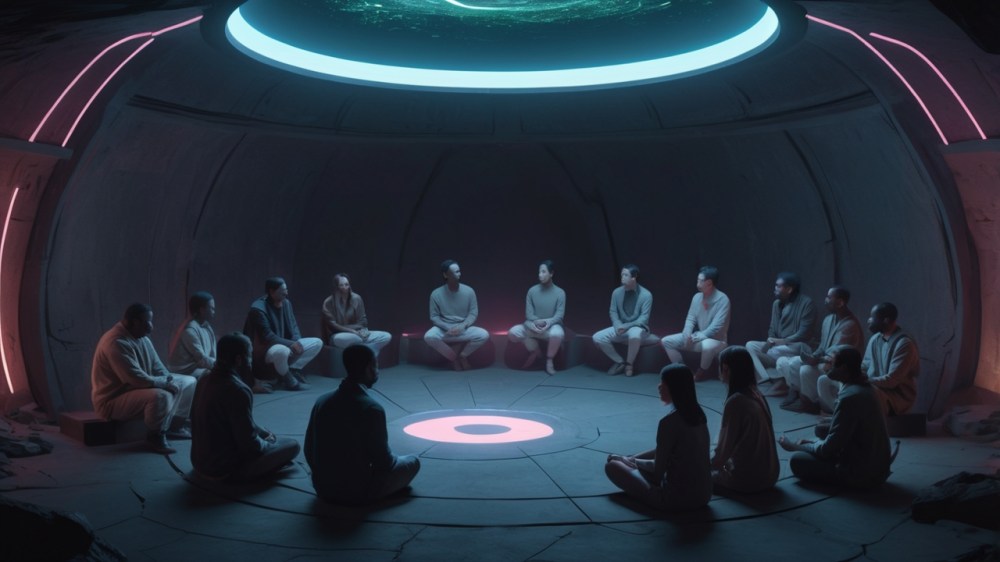
We cope in strange ways. Some of us organize “Memory Trades,” swapping stacks of old Earth memories as a form of entertainment. Others try to simulate struggle—pointless games where we set arbitrary goals just to feel the rush of effort and achievement. One woman, Ava, runs a simulated bakery. She knows she’ll never be the best baker in Dev because the perfect recipes are pre-installed, but she insists on experimenting, adding an extra pinch of salt here, a dash of cinnamon there. She says it’s the unpredictability that keeps her sane.
But not everyone agrees. There are those in the community who argue that Dev is the ideal existence and that our dissatisfaction stems from a failure to adapt. They believe if we were on Earth we would need therapy to change how we perceive the things around us. They think we are struggling because of our expectations of this new world. “You’re clinging to Earth’s outdated philosophies,” says Malik, a former tech billionaire. “This place is what humanity has dreamed of for millennia. Your unhappiness is your own fault.”
The dissent creates tension within our group. Some, like me, feel that Dev has robbed us of the very essence of being human. Others, like Malik, see our complaints as ungrateful and shortsighted. The debates are endless, but they keep us busy.
Our conversations often drift to Negasi, the visionary who created this digital Eden. He is a near-mythical figure in Dev, omnipresent yet elusive. One of our members, an ex-journalist named Clara, has been digging through old Earth archives to learn more about him. “If he’s so brilliant,” she often says, “why didn’t he anticipate this? Did he really believe perfection would save us?”
A few of us have begun drafting a manifesto, a challenge to Negasi’s vision. It’s a risky move; dissent is frowned upon here. But we feel we have nothing to lose. If perfection cannot be questioned, is it truly perfect? What happens when the architect of paradise is confronted with the cracks in his creation?
In the midst of this, I’ve found small moments of symbolic struggle that remind me of my father’s philosophy. One day, I tried climbing a virtual mountain without using any enhancements. It was gruelling. I slipped, fell, and started over countless times. By the time I reached the peak, my arms felt sore—a phantom pain Dev couldn’t entirely suppress. For the first time in ages, I felt alive.
That day, I understood what my father meant. Struggle isn’t just a burden; it’s a gift. It’s the thread that weaves meaning into the fabric of life.
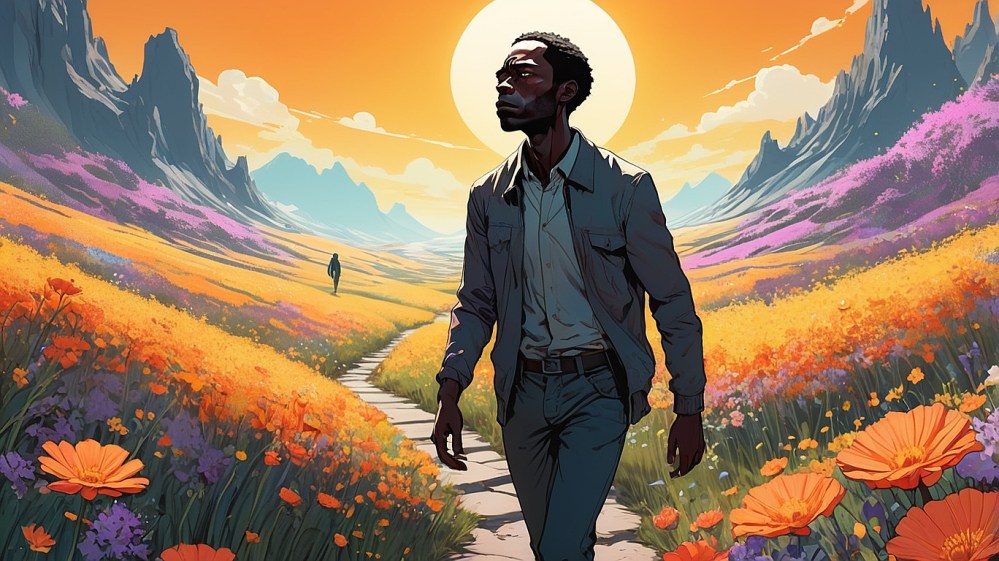
These days—or rather moments—I sound just like him. Humanity needs the struggle because it is the reminder of hope. What are we if all we live for is to experience the same things over and over again? The ascent to the top is too quick to enjoy it. Maybe the journey is the real destination.
Negasi is not God. I don’t think he thought this through because there’s a longing in our souls that cannot be filled with all these things he has on Dev. I’ve told the community that we need to speak up and ask what the overall plan is. At this point, I wouldn’t mind going to the blacksheet or even being deleted completely. Maybe that would bring an end to my misery and frustration. I can’t even get angry. It’s like someone dialled some of my emotions down because I don’t know what I feel sometimes or how to express them. I’m confused and tired of whatever existence this is because it’s not life.
 The Time Tale