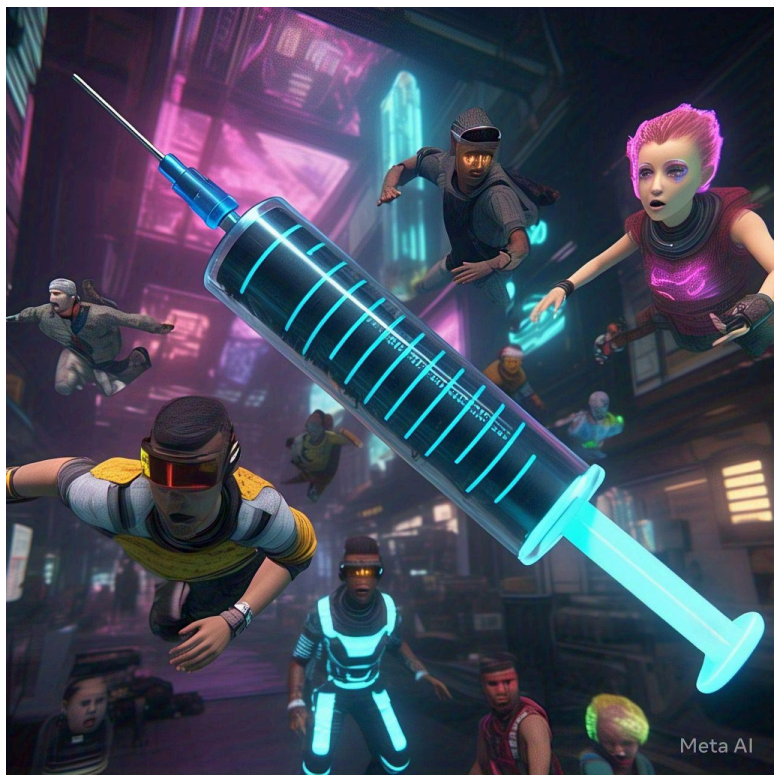
It was never meant to be perfect, and deep down, we all know that. Perfection is
unattainable, and a utopia is just a fever dream. Life, with all its flaws, is a journey, not a destination. But with Dev, it was something else. Perfection wasn’t a dream—it was a drug. We were drawn in, addicted in a way. Takiru Negasi, the creator of the virtual world known as The Development, or Dev, promised “freedom” in this world.
And for a while, it felt like that. The euphoria of the digital world was undeniable. No one
questioned what happened to our physical bodies after uploading.
What happens when we die? That’s a story for another day, I’m not even sure I should be telling this one. I was one of the first Nigerians to upload to Dev. Time works differently here, but I’ve been
online for about seven Earth-years. Back then, Dev seemed like just another virtual world, like
Sim City, but far more immersive with the help of their “uRetina” implants.
I was a popular tech influencer and a gamer, which made me a perfect candidate to try t
uRetina. I streamed my life in Dev, attracting followers and becoming an ambassador for the
program. Then came the Matter Decompactor Pod, or MaDe Pod, which allowed us to transfer our
consciousness permanently into Dev. Some were hesitant, but many of us who had
experienced the freedom rushed in.
In Dev, I’ve been “alive” for five decades. Time here is flexible, but at the cost of me
stacks—essentially the data that makes you, you. The usual institutions like religion and
education had seemed to fade away in Dev, but one constant remained: currency.
But in this world, currency wasn’t money—it was memory.
When we entered Dev, we quickly realized that the world, while vast, was essentially an app
with different “packages” based on memory capacity. Higher-level packages included “passion stacks,” which enhanced simultaneous experiences—like skydiving, attending concerts, and learning history all at once. The lower levels didn’t offer these extra enhancements, but they still offered boundless possibilities. For a time, we were content.
But eventually, the euphoria started to wear off. I was entitled to all the perks, including
passion stacks and time dilation, so I was shielded from the aftershock longer than others.
But when it hit, it hit hard.
Many Dev-izens began to feel disillusioned. Without imperfections, life lost its meaning.
Perfection, in its own way, became a prison. Then, from the depths of Dev, emerged an enigma named Volkov. He introduced a new concept. Pain.
In this world where pain didn’t exist the way it does in reality, Volkov’s creation allowed us to
experience it, making it a strange form of sensation. Ethical concerns? By this point, most had ceased to care. Volkov’s operation remained underground, and Negasi, who controlled the world, seemed either unaware or indifferent.
We traded memories, particularly ones of Earth, for this new experience. Games became
more intense. We could feel the effects of damage, though there was no true death—just
resets that cost memories.
People sacrificed real-life memories for mere moments of pure agony. It was a dangerous path, but no one stopped. By the time the authorities noticed the consequences, it was too late.
Our memory stacks were diminishing, and the damage was irreversible. We had gone too far
into this new world of sensations.
Now, I stand atop the highest skyscraper in Dev, sending this message across all servers.
Below me, Negasi addresses the masses, declaring, “We must transcend our humanity. We
are gods.” I laugh, looking down at the ground far below. Still reeling from the effects of my last pain
experience, I insert my last pain stack into the digital sleeve on my arm, allowing it to settle in.
To whoever’s still out there, outside the Development: spread the word. We aren’t transcending—we’re falling. We don’t seek immortality. All we want is to die.
Love, death and robots,
Maverick.
Written by Udeme Eric
 The Time Tale