

– The Brilliant Negasi Pitch
Global warming was not always a bad thing. In fact, going back to the 1890s, it was something the world looked forward to with hope. People wanted warmer summers and complained of extremely cold winters. When scientists were talking about global warming, many people were excited – except the scientists themselves. Then there was the global cooling phase in the 1970s, largely speculated by the media, and a few scientists. Then in 1988, the US recorded its hottest summer. That year cases of drought and wildfires in the US were also on the rise. The world (mainly the US) knew there was a serious problem and it was already affecting the planet.
The next year, 1989, the world swung into action with the Intergovernmental Panel on Climate Change (IPCC). The reaction was an indication that when the world’s most powerful nations are faced with challenges, the entire world joins their response. A flurry of climate change predictions swept across the world. Different scientists made different calculations but one thing was certain – doomsday was around the corner. It was almost inevitable.
By 1992 the world had accepted the global challenge and was ready to face it. The Paris Convention provided the world with a framework, new targets, and a set of buzzwords and phrases that flooded the conversation – Net Zero Carbon. Carbon Neutrality, Energy Transition, Renewables, and more.
As with every other human agenda, there are two sides to the story.
In developing countries like mine, the truth about global warming seemed really far-fetched. We knew that science had made the impending danger clear, but we didn’t see it as a priority at that time. First, our means of livelihood depended on that energy – a major source of carbon emissions. When the idea of Net Zero Carbon emissions by 2050 was discussed, it was taken as an agenda by the developed countries to tactically evade the problem by pushing it to 2050. We all felt that if it was as serious and grim as they made it seem in the news, nobody would wait till 2050 to reach that resolution.
We also felt it was a way to stifle the development of countries like ours. We understood that the world economy is a ‘see-saw’ economy; If we were to rise, the West would have to lose some of its economic power. So we saw climate change discussions as a subtle agenda to keep us under-developed or developing as they ‘respectfully’ called it then.
These Western countries had used the power of coal and petroleum in the Industrial Revolution and built their economies without restrictions. The climate change conversations had started way before they developed their countries but they conveniently ignored it until they had amassed great wealth, military might and an insurmountable position in the league of Nations. At that time, we had just started combining industry, information, and technology, to catch up with them and they decided to pull the wheels off our cart of progress with climate change demands.
The climate change conversation did not go down well with some of the infamous young leaders of emerging countries. They needed a solution that was a leveller and not one that impacted them more than their counterparts in more established countries. They felt that what would be a convenient challenge for some nations would be a ruthless attack on their growing economies.
Like a well-orchestrated piece, everything came together for the master conductor – Tariku Negasi. Both sides of the climate change argument set themselves up for his proposition. It was the first time anyone had brought up a solution that fairly addressed the concerns of all the parties involved. He knew he had a joker in the pack and he was going to deliver it with finesse and tact. Negasi was never one to shy away from the media; he had planned this speech for many weeks leading to the Summit of 2033. He had written it to inject the right amount of honest fear and the excitement of limitless possibilities. His world-saving, inclusive solution was Development.
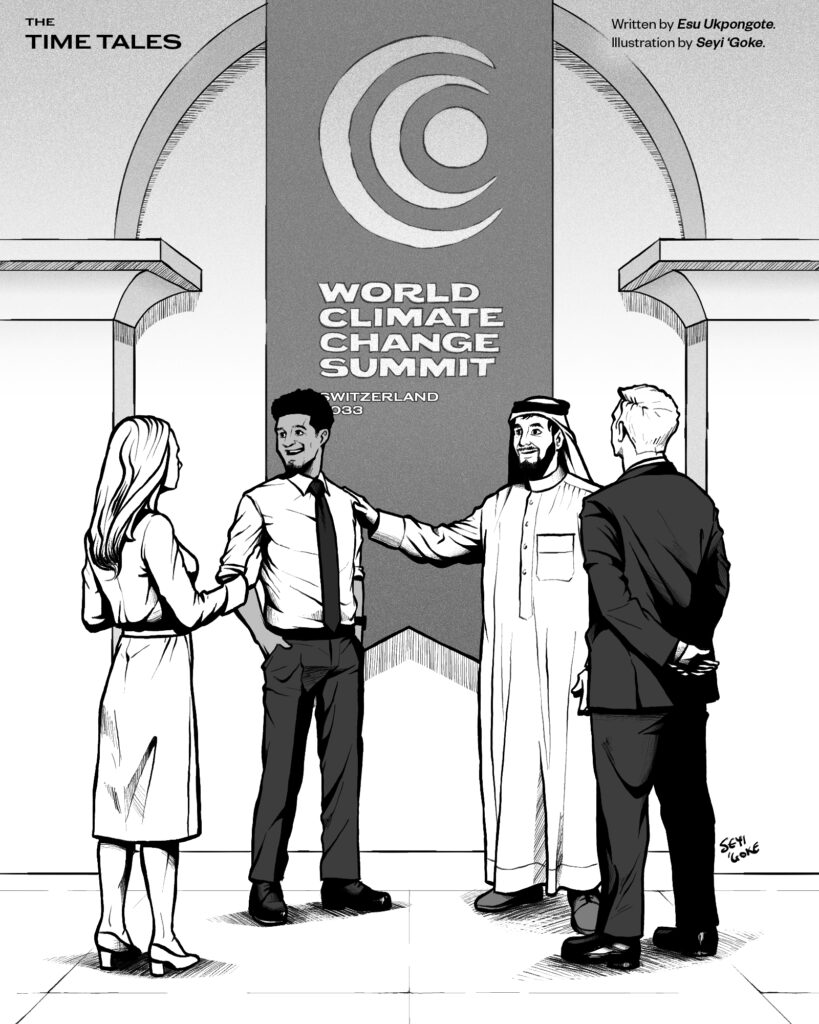
The Summit was scheduled for November 1 – 12th, 2033 in Zurich. Heads of Nations and Youth representatives from different countries and organisations had gathered. The agenda was the same as previous Summits. The only thing that stood out was a 20 minute agenda point – Experimental Methods with Tariku Negasi.
The world needed a hero and Negasi was going to step in as the man with the perfect plan. After a few forgettable presentations that highlighted the looming danger and how little we had achieved, there was a break. Negasi knew he was going up immediately after the break. He sat still with two of his trusted people – an unidentified young woman and the man that had given him a place to build his dreams, Harry Coleman. Together, the three sat down and waited patiently for all the delegates to return after the break. Negasi picked up his tablet and looked through his speech again, while the announcer welcomed the delegates.
After a brief introduction, he picked his tablet and walked to the lectern. He dropped the tablet, pulled out his glasses and looked up for a few seconds to get the attention of the crowd.
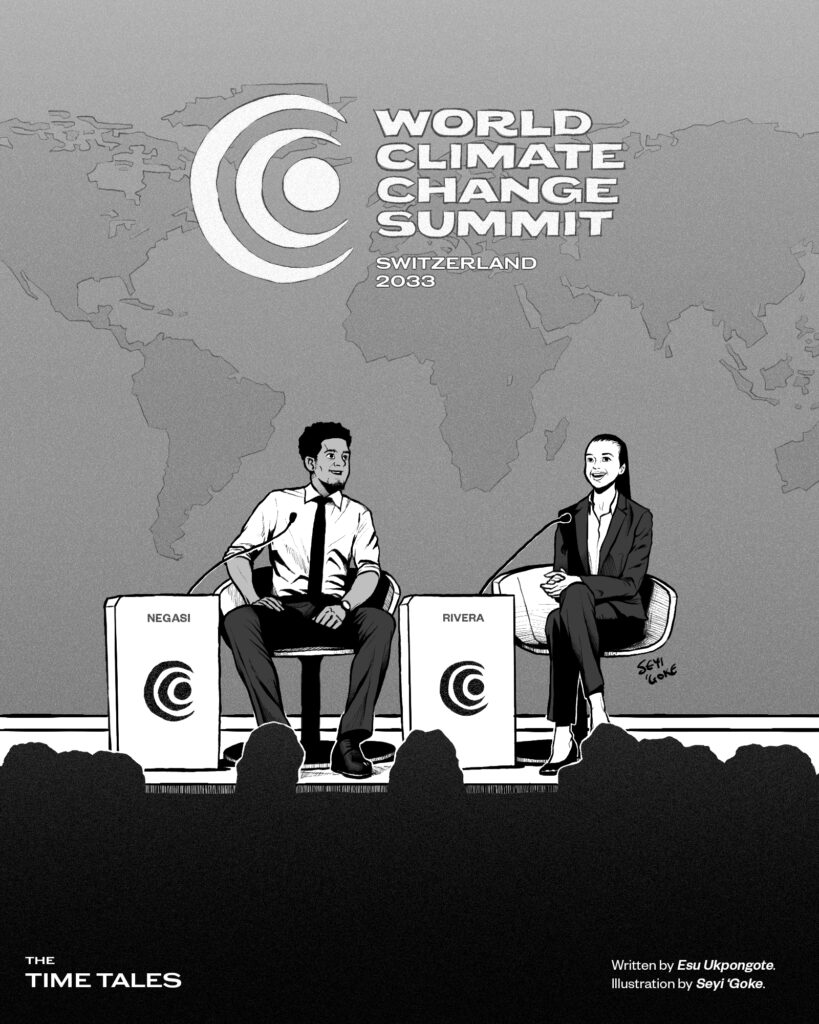
Negasi’s Speech
‘The Secretary-General of the Assembly
Heads of State, Excellencies, Ladies and Gentlemen,
Thank you for giving me an opportunity to share my dream and possible solution for humanity.
For about 200 years man has walked and worked this earth. We have explored and exploited, pillaged and polluted with reckless abandon, and today Nature is angry.
If I may borrow the words of António Guterres, the former Secretary-General. “We fool ourselves if we think we can fool nature.” What scientists predicted many years ago is upon us. “Nature is striking back with fury”.
What we have done over the years is impressive. As humans, we have come together to save our planet, with multibillion-dollar donations and pacts that have helped us reduce the rate our planet is warming.
However, there’s more to the solution than meets the eyes.’
Negasi went on to address the underlying issues of inequality and the supposed attack on the progress of developing countries. He talked about the Western Messiah complex and how years of media representation have made these issues seem like problems of privilege. ‘Africa is bearing an equal share of the burden, yet the continent has contributed the least to the problem.’
The room was quiet. Negasi had a way with words. The speech was compelling but the delivery was even more spellbinding. He had that calm confidence when you know you’re the smartest person in the room but you have to act humble. It was clear he had rehearsed this speech a number of times, with footnotes on his emotional expression on each page.
He continued, this is not a speech about climate change. This is not about slowing the rate of warming and trying to stall an inevitable end. Our existence on the planet means we ourselves would continue to affect it adversely and that marginal impact from growing populations and expanding communities would one day bring us back to this table. I’m proposing a solution that protects the poor and the rich. One that can bring an end to about 80 percent of our emissions in less than 5 years. If you think it is impossible, think again. I’m not asking you to set aside $100 billion dollars a year to fight a challenge. I’m asking you to save humanity. I’m asking for your support as we complete the first Mass Decompactor (MaDe) and full-scale deployment of Development as a parallel Universe of Existence. This is not just about climate action, it is the way forward for the world – Nature and humanity.
We can’t destroy a planet if we don’t live on it. Many times we think of a solution that still has us living on the planet, and by design, we’re made to create waste. We exchange the energy of the world with our flaws so we can survive a little longer on earth. So we think all solutions to climate change have to be gradual, moving us to milder problems but not really solving the real problem. These changes also take time and resources, and both are limited by nature. I and my team are working on a truly sustainable way to save the planet and humanity. We’re creating a new world of possibilities, where waste can simply be deleted into thin air; shift-delete and it’s gone for good – no trace.
There were a few mumbles at this point. It sounded really abstract and too difficult to grasp. The world was already familiar with Dev but having a machine that can just delete mass into thin air was a different subject altogether. Negasi had anticipated this, so he took an unusually long pause to allow them to ruminate over the ideas he just shared.
I see how you are all reacting to my proposition and I would say that your reaction is normal. As leaders in your different nations, the only thing you can offer your people before you get into power is ‘hope’. Most times, that hope is spelt as C – H – A – N – G – E; change. Hope is the currency of politics, and politics has so often promised so much but delivered very little. So, I understand why it is hard to believe in change. But change is inevitable. The droughts and wildfires are rising and changing our ecosystem. Volcanoes are erupting and reclaiming land for nature. We’re experiencing rising sea levels and hurricanes tearing through communities. Change is taking place already; I have seen it with my own eyes – from Dominica to the Sahel to the South Pacific. But that is not the change we want. We have a chance to create the change we want and put our destinies in our own hands.
When challenges arise, like climate change, we are faced with different tests. Science has gone to work, to show us exactly what is happening and how to solve the problem. NGOs and other social work groups rally around to create awareness and sensitize the world. And you, leaders, need to be brave and take action; you need to implement the solutions that science provides.
With climate action, we’ve all passed the science test but we’re getting an ‘F’ in ethics and humanity. We can change the scorecard. Again, with science we’re delivering a game-changing solution. MaDe can take out more than 80 percent of fossil-fuel driven machines that we need for courier, haulage and more. We’re replacing delivery with instant parcel download. There’s so much that we can do with this. If we combine this technology with Dev, we really don’t need to go anywhere physically. We can take more than 75 percent of cars off our roads too, and ensure that the only ones on our roads are electric vehicles. The entire system is powered by green energy – a hydropower plant in Congo Basin, and 2 solar farms out in the Namib desert. It’s the zero-carbon solution for a better world that we’ve all been waiting for.
Negasi pledged to donate more than half of the advertising revenue from Dev to further the research at MaDe. It was a compelling presentation. 20 minutes of hard truth and a game-changing solution to the age-long challenge of climate change.
He promised to start the distribution of the MaDe portals in Africa, stating the fact that they deserved the first solution, seeing that he created everything with African resources. Nobody complained, at least not openly. Most of the Western leaders were even relieved because they were expecting some casualties and did not want to adopt the technology until it was stable. Negasi had already prepared a rollout plan and distribution hubs across the major economic zones in Africa.
At the end of his speech, many leaders chose to skip their sessions, seeing that what they planned to talk about had already been covered and resolved by Negasi’s proposal. That was a huge milestone in the adoption for Dev. Now all he needed was another challenge or disaster to make the world take Dev as a necessity, not an option.