An Integrated Anthology
As told by Kwadwo Bouamah
Filed during the Second General Council of The System
Zurich, 2091
We can’t destroy the planet if we don’t live on it.
— Tariku Negasi, Zurich, 2033
The horror is not loud. It is recognizable.
— From the editorial notes of the anthology
If a word can be removed without loss, remove it.
— A rule Kwadwo Bouamah kept by his desk for thirty-one years
PROLOGUE
The Second Vote
Zurich — The Palais of The System — 14 May 2091
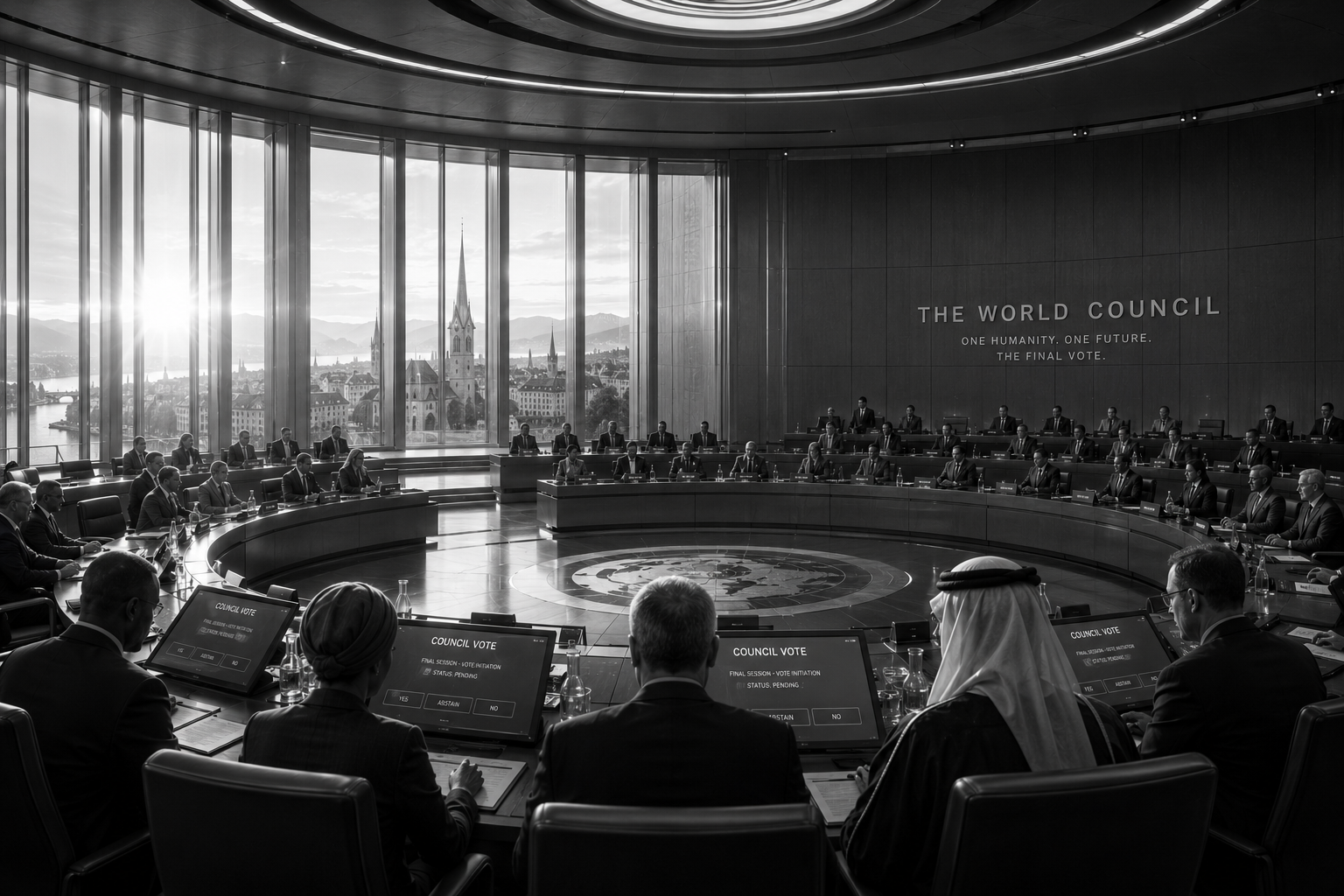
The room was built to be a symbol of Earth’s wealth and authority. The walls were pale stone, cut from a limited quarry in Grisons. The long windows allowed light to hit the room from specific angles that enhanced the amber of the wooden floor. From the ivory lectern on the podium to the plush leather seats for each representative, everything there carried a story of Earth’s exploration, exploitation and extravagance.
That night, the glory of the hall would fade, as the issue of the evening took centre stage. We all had to decide what would be – the world and the people in it, and somehow, I was at the heart of that decision.
I sat comfortably in one of the modest chairs set aside for the Press. From my seat I could see the delegate desks and the seats reserved for observers from civil societies. The names on the plaques had changed over time, but the elegance and weight of power in the room had always remained the same. The United Nations plaque at the head of the room had been replaced in 2049 – it now resided in a museum in The Hague, for documentaries and history lessons. In its place, the words ‘The System’ had been inscribed. It was what the world had chosen to bring countries together and chart the course forward for humanity.
The tag on my neck reads: Bouamah, Kwadwo – Earth.
The Earth accreditation was not a courtesy. It was a category.
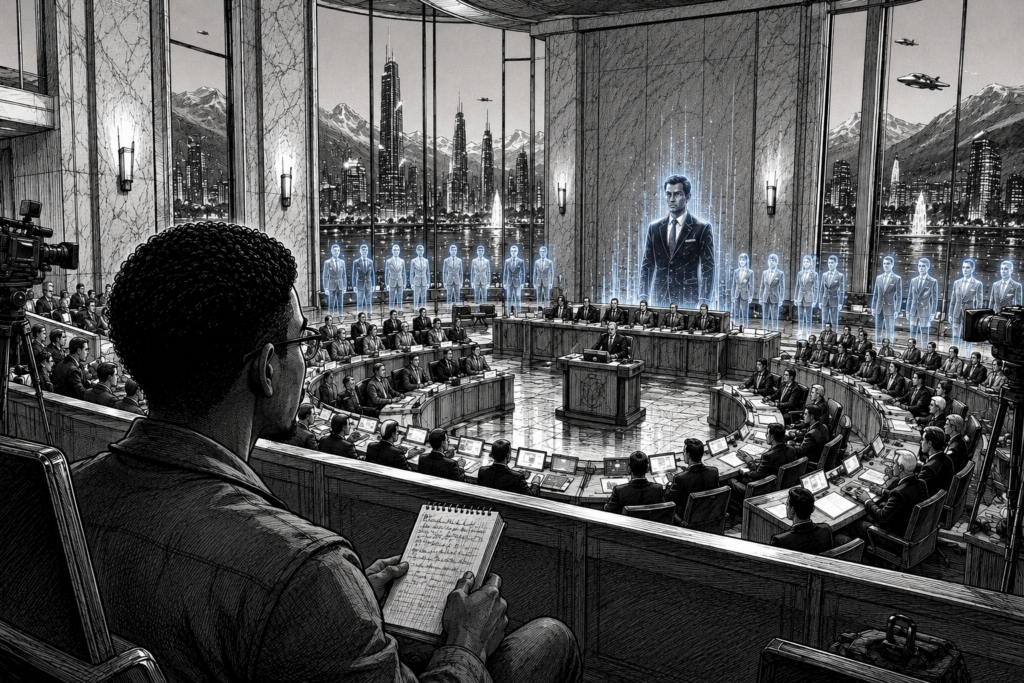
There were two categories of Press in the room, with different agendas. The seats in the other Press category held three people who were present but not physically in the room. The Council had allowed them to project their ‘Sleeves’ so that we could all somehow be present together. They were joining from Dev.
While we waited, I went through my notes again. It was a lengthy story that would take the Council and all present through the events and circumstances that had brought us to that very moment. The story would give context so that everyone understood perfectly before they decided whether the world some of us had created was a world worth keeping.
The Chair entered at twenty minutes past seven, local time. Her name was Ingrid Sørensen. She had been a climate negotiator before she was a judge, and a judge before she was whatever we were asking her to be that night, which I supposed was something between a moderator and a priest. The System did not use gavels. She simply placed one palm on the ivory lectern, flat, and the room fell quiet.
“We reconvene,” she says, “for the Second Vote on the continued existence of Development.”
It was the first time in my life that I had heard those words spoken aloud in that order.
“Fourteen years ago,” she continues, “in the city of New Delhi, a body not wholly unlike this one — smaller, less representative, in hindsight less honest — returned a sixty-eight-to-thirty-two affirmation of Dev as a parallel universe of existence. That vote, known as The New Delhi Summit, has governed our relationship to the digital universe ever since. It made lawful what was already popular. It permitted what was already inevitable. Tonight we are asked, by treaty and by petition, to look at that vote again.”
She paused to allow the weight of that to sink in.
“The question before the General Council,” she says, “is whether the existence of Development remains, on balance, a benefit to the humanity — or whether it has become something we are obliged, by conscience and by evidence, to reconsider.”
I wrote down the words by hand. I always did. I had a notebook and a pen that had been given to me by my daughter the week before she transitioned. It seemed rather odd, given that most people had automated notetakers that listened in and provided summaries and action points. It betrayed my thirty-one years of journalism.
Below me, in the well of the chamber, the civil-society seats are full. The front row belonged to Right Place International — RPI, as most people still called it — the Pro-Earth volunteer network that ran the clinics and the archives and the small, stubborn schools in places the big cities had begun to forget. Their delegate that night was a woman named Adaeze Obi, born in Enugu, trained in Stockholm, who wore an elegant boubou made with Adire. She was perhaps the most morally serious person in that room, and I say that as someone who has met many morally serious people.
Beside her is Pastor Joshua Aremu.
He is not dead. That is the first thing to say about him. The editor’s note at the end of Religious Dinosaurs — the memoir he wrote before the vanishing — stated, with an almost unbearable quietness, that he had disappeared from Lagos in 2086 and that no transition record had been found for him in the MaDe database. For five years, those of us who had read him assumed the worst.
Tonight, he walked into the chamber at Adaeze’s shoulder, thinner than his photographs. He took the seat reserved for the ‘faithfuls’ of Earth. He did not look at the gallery or anyone else. He put one hand on the table and waited. I will learn later where he has been. So will the Council. So, in the end, will you.
The observer screens along the southern wall flickered once, then steadied, and the Chair lifted her palm again. “We welcome the delegation from Development, joining us by network presence.”
There were seven of them. They appeared in their chairs. I recognised six of them from old photographs. A former Chancellor of Germany. A former President of the Republic of Colombia. A former Secretary-General, now without the General. The former chair of the African Union. The former Prime Minister of Japan. The former head of the largest private bank in the world. They looked pale and happy, as if the emotions did not go beneath their skins.
The seventh is Tariku Negasi.
He was the last to arrive. He simply became present, as if he had decided to appear a few seconds behind the others for effect. He was wearing a dark blue suit – a choice that suited the occasion. He was sixty-six years old but looked nothing like it. He could have passed for a thirty-five-year-old man on Earth. His eyes were the same eyes he had had in Zurich in 2033 and in Geneva in 2048 and in the broadcast from inside Dev that we called, for a while, simply Dev Trip 001. I had interviewed him four times in my life. On none of those occasions had I felt entirely that I was speaking to him.
The Chair inclined her head.
“Mr. Negasi.”
“Madam Chair,” he says, calmly and confidently.
The Chair turned to the galleries. Her eyes found mine, which was how I knew what she was about to ask. We had spoken about it, she and I, over the course of three private lunches and one long walk along the Limmat.
“Before we proceed to the formal submissions,” she says, “the Council has asked that the floor be given, briefly, to a member of the Earth-Side press. The request is unusual. So is the question before us. We have judged it appropriate that the chronicle — the whole of it, from the beginning of the man and the beginning of the machine — be placed into the record by someone who has covered it from the outside. The name put forward is Kwadwo Bouamah, of the Accra Desk, author of The World As We Know It. If there is no objection, the floor is his.”
There was no objection. There was, instead, a stillness that was not quite a welcome. I stand. The notebook in my hand is open at the first blank page. I close it.
It is not a night for notebooks.
“Madam Chair,” I say. “Delegates. Observers. All those present in this room” – I pause to consider what present might mean.
I was taught, many years ago by an editor in Accra, that the first pause in any public speech is a gift to the audience, not to the speaker. It tells them that you will not hurry them. If you are any good, it also tells them that you will not lie to them, because most liars do not pause.
“I have been asked to tell you the story of how we arrived at this vote. I have not been asked to make an argument. I will try to keep the two separate, as much as I can.”
“It is a long story. It begins on a hillside in the Afar depression in August of 2004, under a moon-lit night that the elders of the village misread as an eclipse, and it leads up to this moment — in this room tonight. Between those two points, a brilliant man invented the most consequential machine in the history of our species, a universe was built and we now have a choice to make.”
“I will ask your patience and understanding, as I am prone to saying things that I suspect many here do not entirely enjoy.”
A ripple of something that was not quite laughter passed along the front row. The former Chancellor of Germany smiled. I took that, too, as a gift.
“I will begin with the birth of the Man – Tariku Negasi.”
PHASE ONE
In which a child is born under an eclipse, a midwife writes a letter she will not post, and a monastery in Lalibela agrees, for reasons it does not explain, to keep a boy for two years.
The Prophecy (2005-2005)
The Midwife
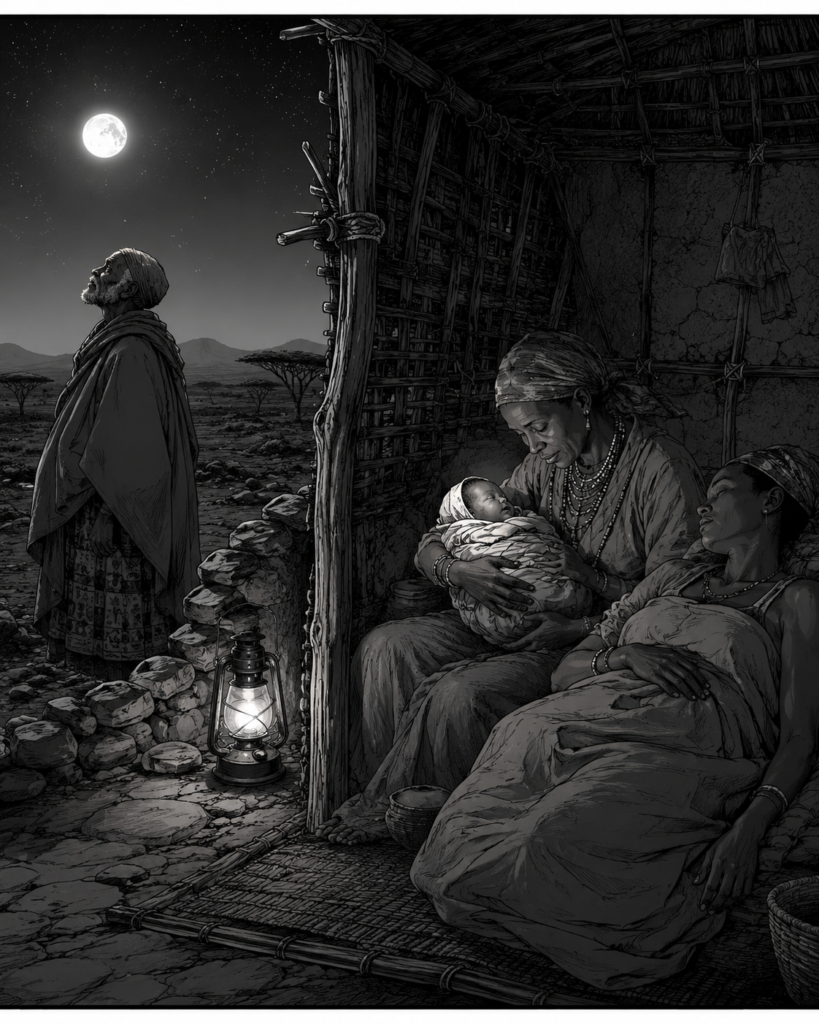
His story begins with a midwife – Aasha. She was from Semera, in the Afar region of Ethiopia, and she had delivered thirty-one children by the summer of 2004. The thirty-second child was delivered on the 29th of August, at fourteen minutes past three in the morning. There was nothing special about that delivery but outside, the universe acknowledged it with the moon in its waxing gibbous phase – a fully lit moon illuminated the Earth that night.
The boy was unremarkable: wet, crumpled, astonished. Aasha wrote, in the account that would later be published in the archive as What the Sky Remembers, that his eyes opened before he cried. She wrote that his mother, who was not young, said only one thing afterwards, which was, “He will be a difficult child.” She did not say it with alarm. She said it with recognition.
An elder of the village, a man called Hassen, examined the child at dawn and went to his hut and did not come out for two days. When he came out he sent for the midwife and dictated to her a letter. We cannot recall all that Hassen had told her to write, but one line the village remembered afterwards was this:
“He will come with gifts in both hands. Watch the hands carefully.”
Aasha did not know, at the time of writing, that this sentence was a warning. She thought she was writing a blessing. She was a careful woman in most matters. She would say, later, that she had been misled by the word gifts.
Lalibela
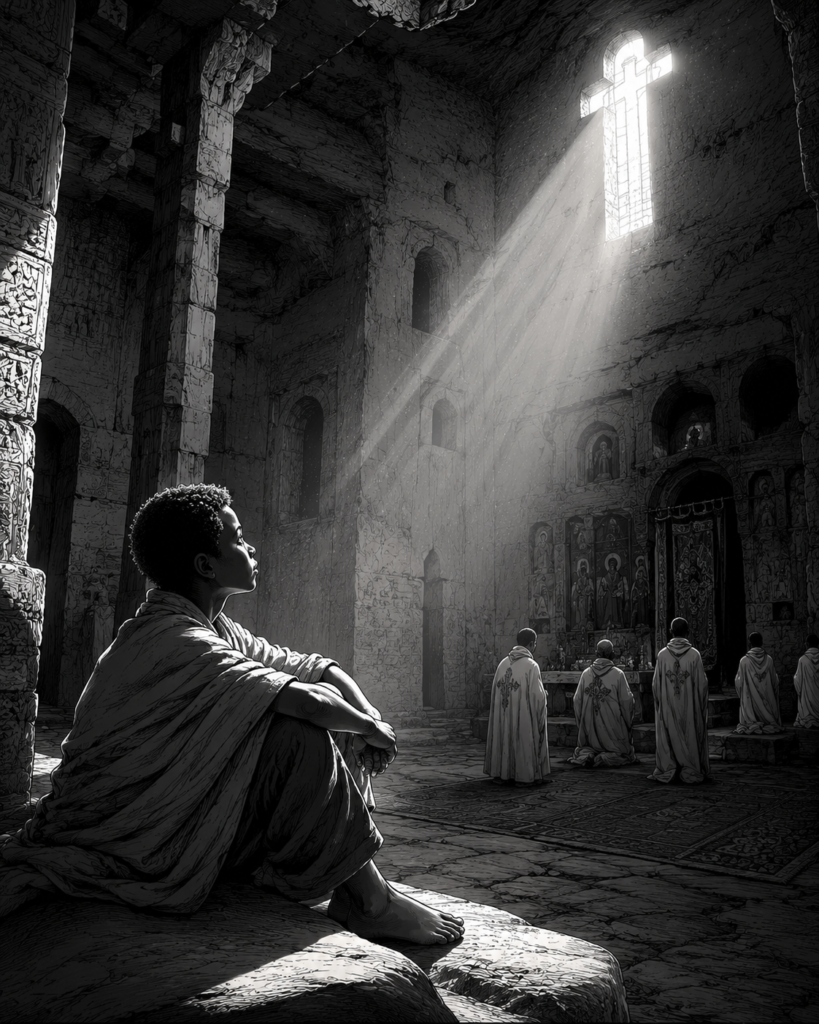
The boy’s name was Tariku. He was given the second name Negasi by his father, who was a schoolteacher and who wanted his son to carry a word that meant king in the old language, though he did not expect him to become one. He expected him to aspire to be one, not necessarily to be the one. Together the name meant more – it translates to ‘History of the King’ or ‘He will reign over history’. He took to the name as one who knew his purpose on Earth.
When Tariku was seven, he disassembled a radio that had belonged to his grandfather. When he was nine, he reassembled it with a modification that allowed it to pick up three additional frequencies, two of them from the Arabian Peninsula. When he was eleven, he wrote a letter to a university in Addis Ababa asking whether he could attend their engineering faculty by correspondence. The university did not reply. When he was twelve, his mother died.
It was after the death of his mother that Tariku was sent to Lalibela.
The rock-hewn churches of Lalibela are among the oldest pieces of built Christianity still in continuous use. They were cut, according to tradition, by angels during the night, though the archaeologists prefer a longer explanation. A priest there, whose name the chronicles do not preserve, agreed to take the boy as a temporary pupil — the arrangement was to last three months but it lasted two years. The priest never explained the extension or the additional activities that the boy partook in. He was sent to study the old texts and the carvings and the patterns of the natural light that fell into the churches at different hours of the year, and he made, during that time, no friends that we know of and spoke to no one outside the complex except his father, who visited twice.
It was in Lalibela, his biographers would later write, that Tariku Negasi acquired the habit that governed the rest of his life: the habit of watching a thing until it manifested. He watched the light move across the walls for two years. He watched the priests pray until things seemed to change. He watched the rains come and fail and come again. He watched, according to one account, the same stonemason restore the same corner of the same pillar three times because the mason could not find a solution to a crack that kept returning. When the mason at last returned to the pillar for the fourth time, Negasi — who was by then thirteen — offered him a solution. The solution worked.
“It was not a clever solution,” the mason would later tell an interviewer for The Man Tariku Negasi, the most widely circulated of the early profiles. “It was only that he had watched it longer than I had.”
The Boy with the Computers
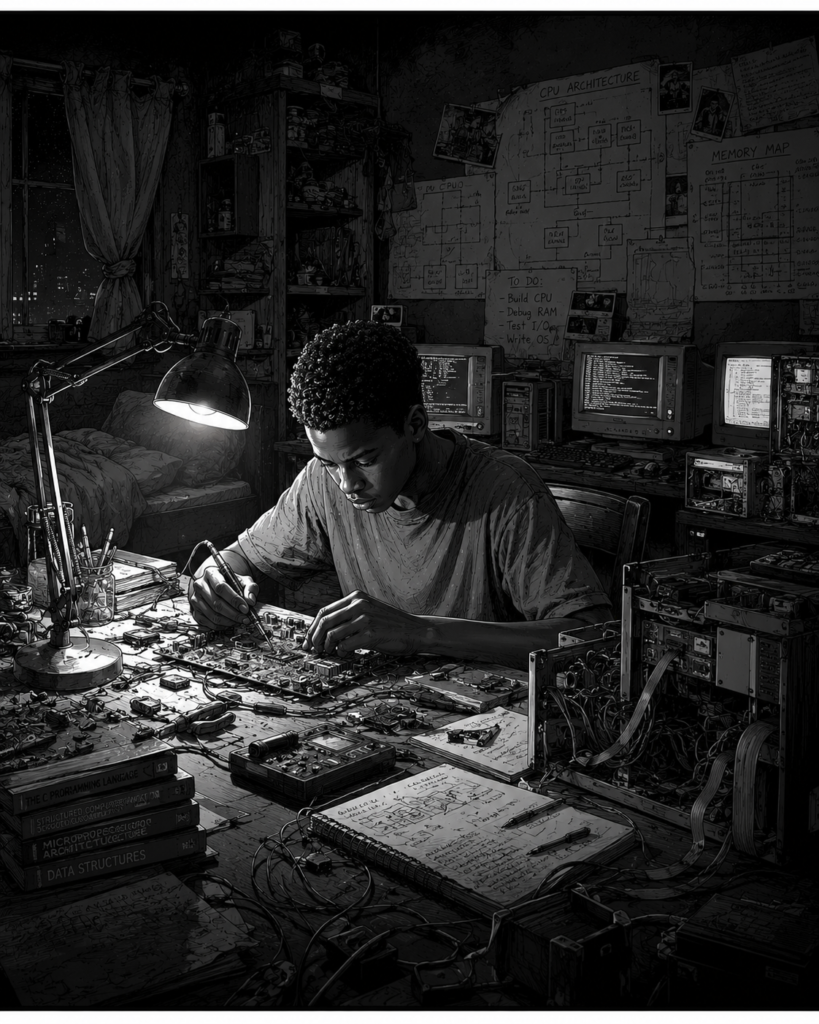
He returned to his father’s house at fourteen. By the end of that year, he had built a computer from salvaged parts. It was at this point that his father noticed his unique understanding of systems and how to manipulate them to create better ones. By the end of the following year, he had built three other computers and had casually joined a network run, loosely, by hobbyists in Nairobi. A few culture magazines had covered his work and he was a regular at youth and tech exhibitions across the country. Negasi’s work found its way to a retired professor in Munich who was convinced, for a period of several months, that he was speaking with a graduate student.
In 2017 he travelled, for the first time, outside Ethiopia. He went to Berlin, where he attended a conference on ambient computing and where he met, in a coffee line, a woman who would later finance his first company. The company made a head-mounted display called the uRetina, which was lighter than the existing products, cheaper than the existing products, and — crucially — did not require a tether. The device sold poorly for eighteen months and then, in the spring of 2019, began to sell in volumes that its factories could not meet. The reason was that the world, unprepared, had been given a reason to stay indoors.
The pandemic took the things that the world had been reluctant to try and made them important. Virtual activities became the norm. Schools, offices and events moved online. In that wave, one of Negasi’s pet projects – a three-dimensional social environment he called Development, or Dev – also became an important piece of technology. Pieces of Negasi’s puzzle began to fall into place. The uRetina became the tool for the most immersive virtual and it helped the adoption of Dev. Between April and October of 2020, it gained roughly a hundred and eighty million users.
By then he was twenty-one; an exciting young founder from an unexpected country. The Global Health Organisations warned that prolonged stay in this virtual environment and the use of the uRetina had physiological effects that had not been studied. The warnings were widely reported and narrowly heeded. A generation of young people confined to rooms still chose to strap the device to their heads and go anywhere they wanted, for as long as they desired.
The First Signs of Acceptance

It was in this period — these first years of Dev, when it was nothing more than a social environment, that the first signs of acceptance began to surface. They did not appear in the newspapers. They appeared in journals, podcasts and social media conversations.
A retired lighting designer in Montreal, whose journal I read twenty years later as part of the archives, wrote that she had begun to prefer the version of her living room that she had built inside Dev to the version she had actually furnished. A teacher in São Paulo wrote that his students were better behaved inside the classroom he had constructed than inside the classroom he was paid to supervise. A woman in Seoul wrote that she had begun to attend, on Sunday mornings, a Dev church in which the pastor was a rendering and the hymns were recorded, and that she found the services calmer than the services at her actual parish, where her actual neighbours were present.
None of these were scandals. They were simply the first of what would become The Letters in another fifty-something years. These first signs of acceptance showed that people would return to spaces where they were allowed to be themselves and leave the familiar, if it made them feel a little shame or discomfort.
Negasi, who had read widely but not sentimentally, understood this earlier than most. Whether he understood it as a warning or as an opportunity is one of the questions that this Council must decide tonight.
PHASE TWO
In which the United Nations loses a vote it did not know it was taking, a private founder is allowed to speak on a floor he has not earned, and the word Assembly begins to mean something else.
The Fall of the Old Order (2040 – 2049)
The Eastern Revolution
The chroniclers of the period sometimes use the phrase Eastern Revolution to mean the political realignment of the late forties and sometimes to mean the economic one. They are, as so often, the same story told from opposite ends.
The political end begins in Beijing, in the spring of 2042, when a younger generation of ministers pushed for what they called a departure from the posture of apology. The Chinese state, which had been the most enthusiastic early adopter of Dev for reasons of state planning, announced that it would no longer participate in the annual G20 climate reviews, on the grounds that the reviews had become a performance of piety. The United States, which had not been expecting the move, responded within a week by announcing that it too would reconsider its participation. Russia, which had been waiting for permission, announced the same within forty-eight hours. What followed, over the next seven years, is recorded in the chronicle we know now as The Eastern Revolution.
The European Union held together, formally, until 2046. The United Nations held together, formally, until 2049. Both had ceased to do the work they were created to do some years before the formal end. The last three General Assemblies were conducted under conditions the outgoing Secretary-General called exhausted cordiality. There were no fights. There were no walk-outs. There was a great deal of smiling and a great deal of press-room coffee, with little that would change the world for the better.
The Assembly of 2048
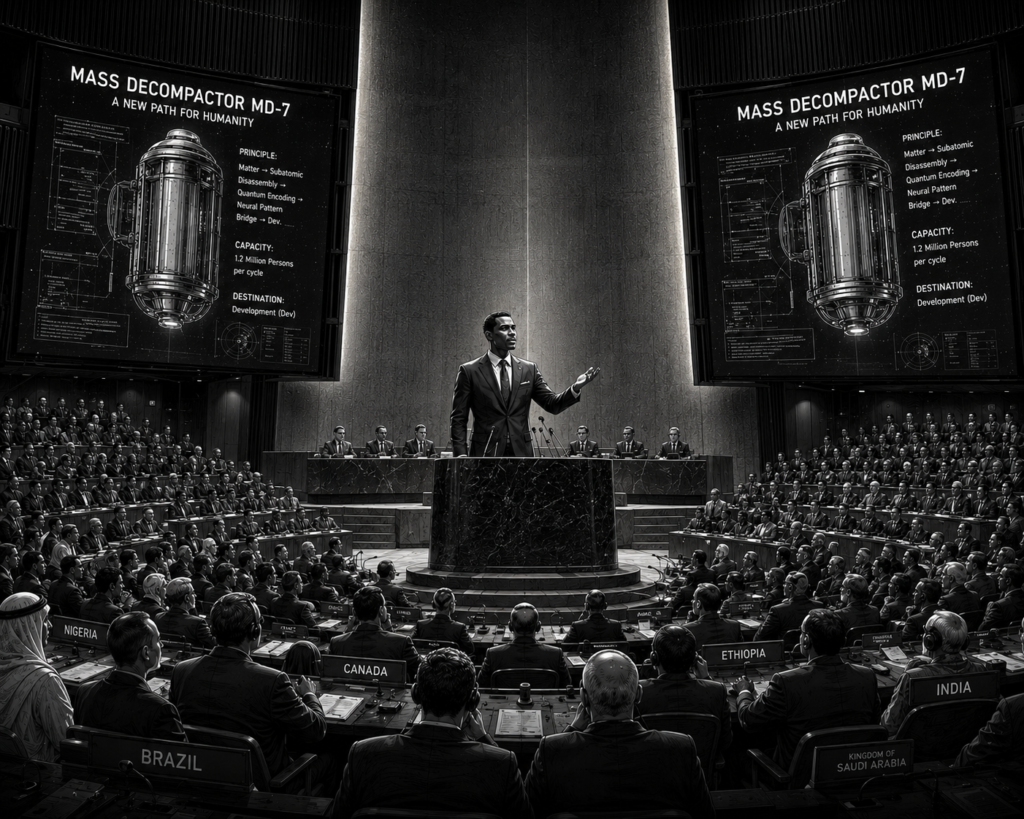
I was in Geneva on the fourteenth of September 2048 for The UN General Assembly of 2048, the last Assembly to be chaired under the old charter, and I was on the floor when Tariku Negasi was called. He was not a Head of State or a foreign minister but he had been credentialed, at the last minute, under a provision written for laureates of scientific prizes. It had never, in the six decades of the charter, been used to permit a private founder to address the Assembly. The delegations that objected did so quietly, because the delegations that supported him had more power in the Assembly. These members had already begun to build Dev annexes of their own embassies.
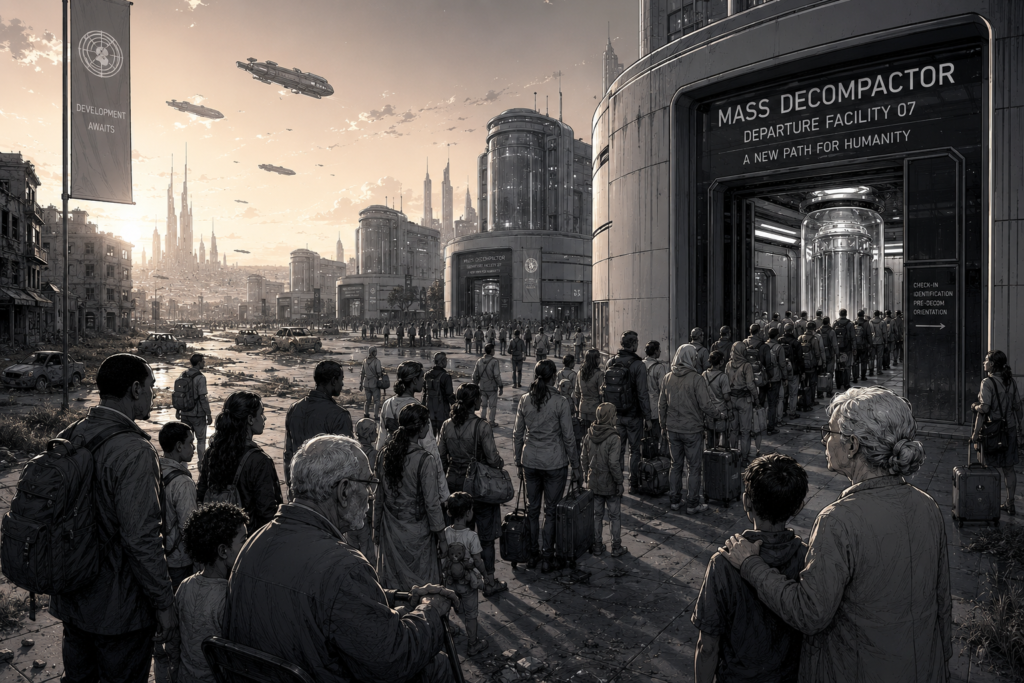
What he announced was the readiness of the Mass Decompactor – MaDe.
I will not reproduce the speech here. The full text is in the archive.
Negasi proposed a multilateral transition facility, an international body seated in Switzerland, that would oversee the orderly movement of populations from physical to digital existence. He painted a picture of digital existence that ticked all the boxes, as a solution to humanity’s most publicized challenges – not necessarily the most pressing needs. This distinction is important for the decision we are here to make.
Negasi did not propose to run it. He proposed to serve on its technical committee. The body would be governed by a council of states, with non-voting representation from the largest private operators. The acronym he offered was UoG. Union of Governments.
Six hundred delegates understood, within minutes, that what they were being asked to ratify was not a technology. It was a successor to themselves. Three hundred voted in favour, on the understanding that the alternative was to be succeeded anyway. One hundred and sixty voted against. The remainder abstained, which is the parliamentary form of grief.
The United Nations dissolved formally the following summer. The System — the Union of Governments — inherited the building, the letterhead, and approximately a tenth of the staff.
The Architecture of The System
On paper, The System looked like what it had replaced. A General Council, a rotating chair, a set of technical sub-committees, a great deal of glass. Underneath, it was different.
Negasi’s technical committee had, by 2052, evolved into a permanent executive of four shadow units, never officially named. Unofficially, the four units were the Gatekeepers, who controlled who moved and when; the Architects, who designed the basic environment for Dev; the Librarians, who held the stacks — the archived memories of the transitioned population; and the Hounds, who were tasked with finding what their masters asked them to find.
A staff memo which later formed the basis of the document we know now as The System, leaked to me in 2059 by a former Gatekeeper who had lost a daughter to a preventable transition error, described the four units in these terms: Gatekeepers manage the door. Architects build the rooms. Librarians remember. Hounds correct. There were rumours that the Hounds did not only correct, but they did edit and delete – casually disabling Stems – Dev inhabitants – who acted in ways they described as chaotic. A Stem, in the technical sense, is the computational spine on which a given consciousness runs. To disable a Stem is to end a life. The Hounds had been, at various points in the history of The System, twelve people, sixteen people, nine people. Nobody outside the unit has ever reliably known.
I will return to the Hounds. For now, the Council needs to carry only one fact away from this phase: by the middle of the fifties, the machinery existed, and the machinery was not governed by any body that had been elected.
PHASE THREE
In which MaDe becomes operable, a broadcast is made from the inside, and the Council is asked, belatedly, where the first volunteers came from.
The Machine Opens Its Eyes (2055 – 2067)
The First Version
The paper that set out the theory is known in the engineering community as MaDe 1. It was published in the Journal of Applied Bioelectronics in 2054 and is forty-one pages long. Forty of those pages describe an elegant and plausible method for converting the pattern of a person into a stream of electromagnetic information. The forty-first page describes a plan for clinical trials.
The clinical trials were the first problem.
Between 2058 and 2063, the first human transfers into the Dev substrate were allegedly conducted at four facilities. Three were in Switzerland, under the formal supervision of The System, using volunteers drawn from the terminally ill and from a Swiss-registered foundation that offered a significant fee to the estates of participants. The fourth facility was in a complex outside Lanzhou, in the People’s Republic of China, which had been permitted by bilateral agreement to conduct its own trials under national protocols. These protocols were not published publicly.
It has since been established — and the evidence is set out in the investigative file now known as Dev Trip 001 — that the volunteers at the Lanzhou facility were not volunteers. They were prisoners. The majority had been sentenced to death. Their participation in the MaDe trials was presented to them, according to the interview transcripts recovered in 2081, as a commutation. The paperwork was drafted in a way that made it look like one and it was signed without consideration.
Of the seventy-four prisoners whose patterns were taken in the first two years of the Lanzhou trials, forty-one arrived in the substrate in a state that the engineers were willing to describe as viable. The other thirty-three did not arrive at all, or arrived in a state that required immediate correction.
The Broadcast
In September 2067, Negasi announced that he would enter the substrate himself and broadcast, for twenty-four hours a day over a period of six weeks, from inside. The broadcast was unprecedented. The press called it The First Dev Trip. The System’s own internal reference for the event was simpler: Dev Trip 001.
I covered the broadcast from a studio in Accra. It was a little underwhelming, as we simply watched Negasi walk through rooms like we were watching the recordings from a security camera. Nothing interesting happened, but he seemed content with being present in that world. We did not fully understand what it meant, because it still seemed like just another video on the internet.
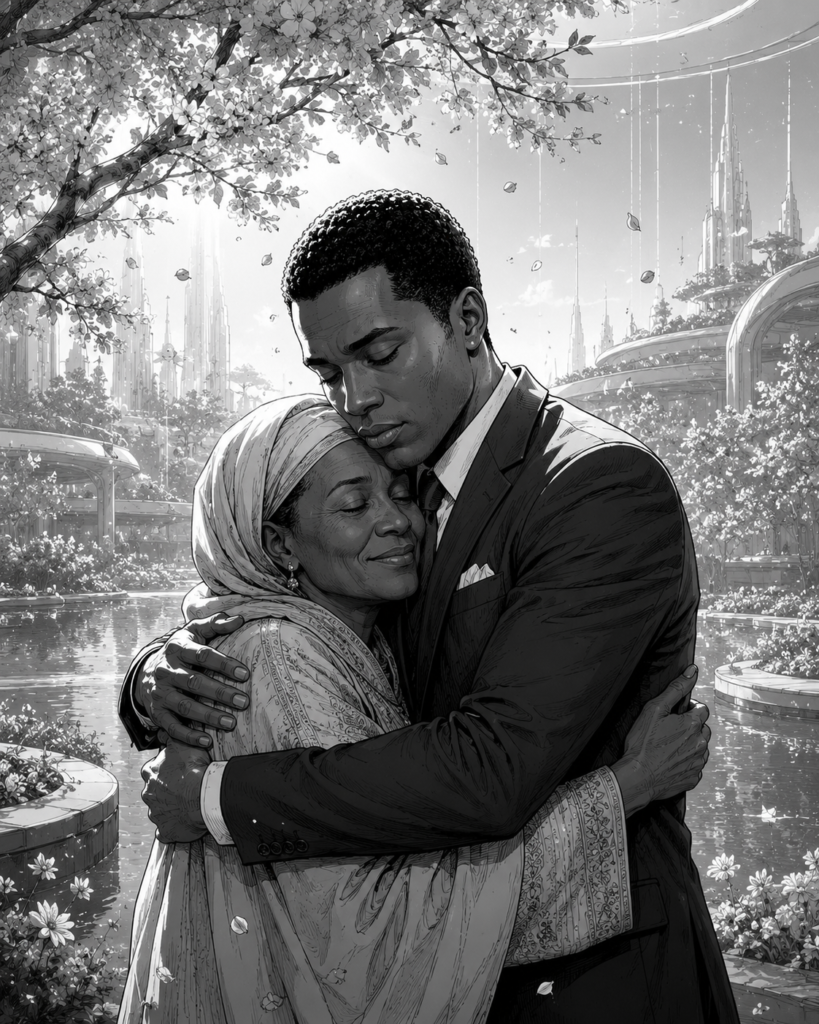
The most memorable part of that broadcast was watching Negasi meet up with a reconstructed and recreated version of the mother he had lost at the age of twelve. The meeting was not announced in advance. According to the Architects who set it up, it was not staged or choreographed. His emotions and the warmth were meant to be real. The Librarians had reconstructed the mother from family recordings, photographs, and written correspondence. The reconstruction was sufficient, Negasi said, for him to feel that he had had a conversation with her. He would not say that the conversation was with his mother.
At the end of six weeks he did not return. He did not announce that he would not return. He simply kept broadcasting – less of himself and more of everything else on Dev, until the world stopped seeing him. The question on everyone’s lips was “why has he not come back?”
The New Type of World
Dev in the late sixties was not what Dev is now. It was smaller and less densely populated. The Architects had built districts that had been requested — a recreated Lagos of 1978, a recreated Kyoto of 1954, a Paris that had never existed except in paintings — and the residents had begun to move between them and to make new friends.
The first Dev social systems permitted residents to construct companions from templates. The templates, the promotional literature said, were intended only for temporary use as emotional and physical support. Many residents did not stop at creating one or two of these ‘Friends’. After the Wave of Desertion that brought most people to Dev, the System discontinued the creation of ‘Friends’ but did not eliminate all those already created. Social engagements for real residents became mundane and predictable with these Friends.
The residents also began to discover that the timelessness of Dev was not a gift. It was an absence. A woman whose Dev testimony would later be filed, anonymously, under the title We Want Sex, expressed this emptiness. She closed her letter with the line that has been quoted many times since – “We tried to build what Earth had given us for free. We could not build it”.
PHASE FOUR
In which a man in Edinburgh says what he knows, a founder replies with the patience of a physician, and a summit in New Delhi produces a number that governs everything that follows.
The Whistle and the Vote (2070 to 2077)
Daniel Fraser
While Dev continued to gain popularity among people on Earth, a group of people had followed curiosity and threads of conspiracy.
In June of 2077, a man named Daniel Fraser walked into the office of a solicitor in Edinburgh and deposited, with instructions, a thumb drive. He was the Head of Engineering, Platform Integrity, at MaDe. He had two children. He had a wife who worked in paediatric anaesthesia. He had a series of suspicious experiences. From being followed to getting his dog poisoned and other things he had initially ignored.
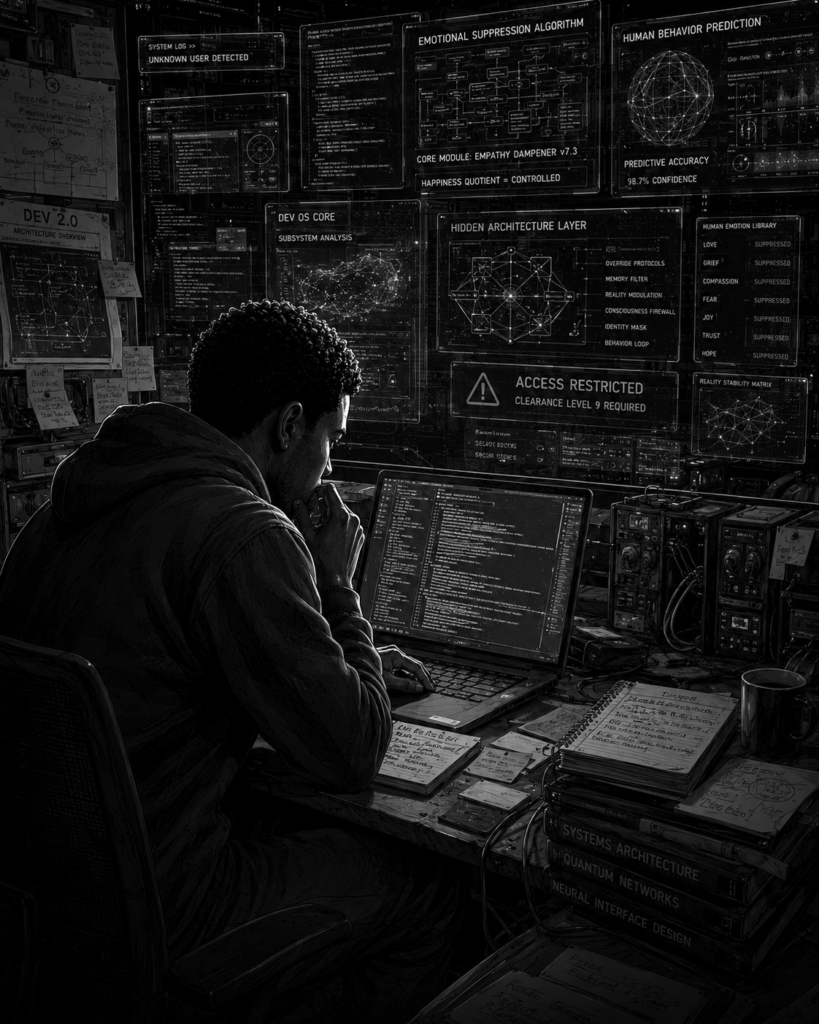
The document he deposited is preserved in the archive as Conspiracy Theory. The document describes what Fraser called the Quiet Layer.
Fraser claimed that the Quiet Layer was an emotional-suppression apparatus running, continuously, beneath the surface of the Dev experience. It did not prevent people from feeling. It prevented people from feeling enough. It modulated the highs and the lows. It returned its subjects, reliably, to a band of affect that the engineers, in their internal notes, had labelled Contentment. The band was wide enough to include mild joy and mild sadness. It was not wide enough to include ecstasy or grief.
The document’s most consequential claim, and the one that has been argued over in courts and in bars and on the Dev forums ever since, was the claim about the backdoor. Fraser wrote that the journey to Dev was not a one-way trip, and that only one person had access to the backdoor. That person is Tariku Negasi. Fraser believed Negasi also had an override switch for the Quiet Layer – even if he had never used it. He thought the Council, whichever body that turned out to be, should be told.
Fraser was found dead, two weeks after depositing the document. Officially, he had slipped and was found at the bottom of a staircase in his own home. The death was ruled accidental. His wife did not accept the ruling. The coroner did. The documents he had deposited in Edinburgh were published, by arrangement, six days later.
The Reply
We all recall the series of stories, videos and broadcasts that followed the death of Fraser. Negasi must have distributed them to every major newsroom in the world within forty-eight hours of the leak. It is currently preserved as The Response in the System’s archive. It is not long. It is written in the patient, almost medical tone he had cultivated since his twenties. It acknowledges that a suppression layer exists. It argues that the layer is therapeutic. It invites the reader to consider what the alternative would look like — a substrate in which nine billion human beings could experience, simultaneously and without mediation, the full register of their own feeling. He asked whether any room built by human hands could bear that.
The reply was an admission in the form of a defence. It conceded that the mechanism exists but it challenged the morality. It moved the ground of the argument from fact to ethics. We have to carefully consider this as we decide tonight.
The reply also did something else. It named, for the first time in a public document signed by Negasi himself, the existence of the oversight group. He did not say who was on it. He only mentioned that the group had been in continuous operation since 2052, that it had reviewed every significant modification to this ‘Quiet Layer’, and that all the modifications would be made available to any competent tribunal with jurisdiction. No such tribunal yet existed. He was willing, he said, to submit to one.
Three months later, the Council of The System announced that the tribunal would be convened. Its name, when it came, was not Tribunal. Its name was Summit.
New Delhi
The New Delhi Summit of 2077 was the first and, until tonight, the only global vote on the continuation of Development. It was chaired by Dr Priya Varma, who had been the Indian Minister of Science and Technology and had agreed to chair the summit on the strict condition that she would be permitted to set the question. The question she set was this: Should the practice of transitioning human beings into the Development substrate continue, and under what conditions?
The vote was not a referendum of the Earth population. It was a weighted vote of the sovereign members of The System, with advisory votes from observer delegations including, for the first time, a small number of residents of Dev itself. The result was reported as sixty-eight per cent in favour and thirty-two per cent against. The conditions attached to the in-favour vote ran to three hundred and eighty-four pages. Most of them were honoured in the breach.
I remember the night the result was announced. I was in a hotel bar in Mumbai. I had been travelling with Fraser’s widow, at her invitation, because she had asked for someone to be with her when the number was read. The number, read out by Dr Varma on a stage strung with the flags of one hundred and forty-one states, took the air out of the room. “They voted to keep it,” she said quietly. It was depressingly quiet after that.
Within eighteen months, the Dev Campaign had been launched, fronted by the world’s most admired artists. Among them was the musician known as Kytz. He had accepted the commission because he had believed in it. He would, within four years, regret it. I would like the Council to note that we could not find Kytz or any record of where he may be, to get his testimony.
PHASE FIVE
In which the price of the premium sleeve rises, a pastor stays behind, and the letters begin.
The Wave of Desertion (2078 – 2084)
The Sleeves
After New Delhi, the Wave of Desertion was formal. It had been informal for years — the wealthy had been transitioning quietly since the early seventies. But after 2077 the practice was advertised. It was sold to the world with jingles, extensive PR campaigns and a lot more that the algorithms and systems permitted. There was an economy sleeve and a premium sleeve. The economy sleeve, at its introduction, was priced at twenty-two thousand international credits. The premium sleeve was priced at one hundred and forty thousand. The difference between the two was not, despite what the marketing claimed, fidelity of pattern. The fidelity was the same. The difference was the rooms you were allowed to enter and the memory access you got when you arrived.
The rooms on the inside of Dev were not equal. They never had been. Nor were the residents equal, given that some had access to more memory or different levels of privilege. I share this to highlight the fact that humanity had not eliminated hierarchy – it had merely rebranded it and helped it transition along. People who had transitioned into economy districts sometimes reported that their memories of their Earth lives felt “thinner”.
Pastor Aremu
I will speak about Pastor Aremu, without deferring to him – as he is present with us at this council.
Pastor Aremu was the leader of a congregation called New Life Assembly. He recorded his struggle with the Wave in a long testimony that was published, in 2081, under the title Religious Dinosaurs. He was forty-four when he wrote it. He had been preaching for sixteen years, and in the last two of those years, he wrote, the potency of the message had begun to fade in the same way that his body had begun to. I urge you all to find some time to read his letter. It was one of the first letters I read that made me reconsider the magnitude of the shift that Dev had introduced.
Pastor Aremu had publicly challenged Negasi and had spoken at different media houses about the dangers of the entire scheme. Strangely, the media houses moved on from him, like a story that had lost steam and was slowly folded into the history folder. He was systematically deplatformed and he subsequently disappeared from Lagos in the summer of 2086. The editor’s note appended to his testimony, published afterwards, stated that no transition record had been found for him in the MaDe database. It was a short note. It left, between its sentences, enough space for several possibilities. Seeing him today leaves us with more questions than answers. I believe he would share with this council before we vote.
The Letters
I will not try the Council’s patience by reading out all of the letters. I only ask that the delegates consider the testimonies of few more people whose lives have been impacted by the introduction of Dev. You can find some of them in the Letters, where more people from across the world have shared their unique experiences. However, for the benefit of time, I’ll touch on some that give deeper context for the decision we are about to make.
The letter by Ngwadi Dingiswayo titled The Weight of Memory, opens up a fresh thread of unspoken fears. Following the centralization of memory, the history, identity and heritage of everyone in Dev now lies in the hands of one man. If he can change memories, he can rewrite the entire history of humanity, our legacies and even the decision we will make here tonight. It means the story of our evolution, as a species, will lie at the mercy of one man’s opinion, interest and agenda, depending on your decision. Whether this is a good thing, and the world we want to live in, is up to us to decide.
The Letters, continued
In Tokyo, a man called Kiyoshi Masayuki wrote in the record we know as Hikikomori that he had been afraid to leave his house for thirteen years. The transition to Dev served as a gift for people like him with social anxiety and other mental health challenges.
Dev also gave people a chance to actually be what/who they chose to be. They didn’t need to ‘identify as’ when they could simply become what they desired. It erased the significance placed on physical differences like gender, race, height, appearance, accent, and more. It gave people the chance to bond on the basis of values and capacity.
However, these elements of equality should not make us turn a blind eye to the systemic inequality in Dev.
A German civil servant called Patrick Berger wrote in the record we know as Between the Lines that he had moved to Dev to escape the lines — the lines of nationality, of colour, of gender, of language, that had disfigured the public life of his century. Dev had promised to dissolve the lines. It did, but it had also drawn new ones. He could not say, in Dev, who could afford the beautiful districts, but he could walk along the borders of those districts, and he could see. The new lines, he wrote, were neater. They were still lines.
There are many more perspectives of discontent that have fallen through the cracks of what I believe is a rigid system that silences dissenting voices in Dev. One of such letters came from a Nigerian man called Daniel Takim Out who wrote in the record we know as The Paradise That Killed Humanity that he had come to Dev not from necessity but from curiosity. He had discovered, in the substrate, that he missed the thing his father had tried to warn him about. The beauty of the struggle – the joy of working towards a result and achieving it, not just the instant appearance of results. On Earth, his father had said, perfection was death in disguise. In Dev, he understood those words.
The Letters, concluded
I will bring one last letter to your attention because it asks a question that we should also consider. A young woman who signed herself only Maya, and later Azeez, wrote in the records we know as Fractured Facades and Finding Fake Friends that she had met, in Dev, a friend called Andra who had known things about her that no one should have known. Andra, she later learned, had been stitched together, without her consent, from the archived stacks of three people who had been acquaintances in her Earth life.
This is what happens when people have access and control over collective memories. While they can spot crime before it gets executed, they can also manipulate people and records to align with their agenda. Maya’s letter ends with a question for us. She asks whether the privacy and integrity of a memory survive the death of the person to whom the memory belonged. It is not a rhetorical question. It still demands an answer.
The answer to this, and all the other issues that we are faced with as humanity, depends on your decision tonight.
PHASE SIX
In which six people with reasons of their own begin to take the substrate apart, and discover, to their considerable regret, what is inside it.
The Invaders (2083 – 2087)
The Puppet Master’s Strings
We have heard of Negasi, the System and testimonies from people who were watched or experienced the transition to Dev. What we still don’t know clearly, is Negasi’s mechanism of control – the Invaders.
The story of The Invaders has been told by several hands, and each retelling has agreed on the cast and disagreed, frankly, on the tone. I will tell it as I have come to believe it.
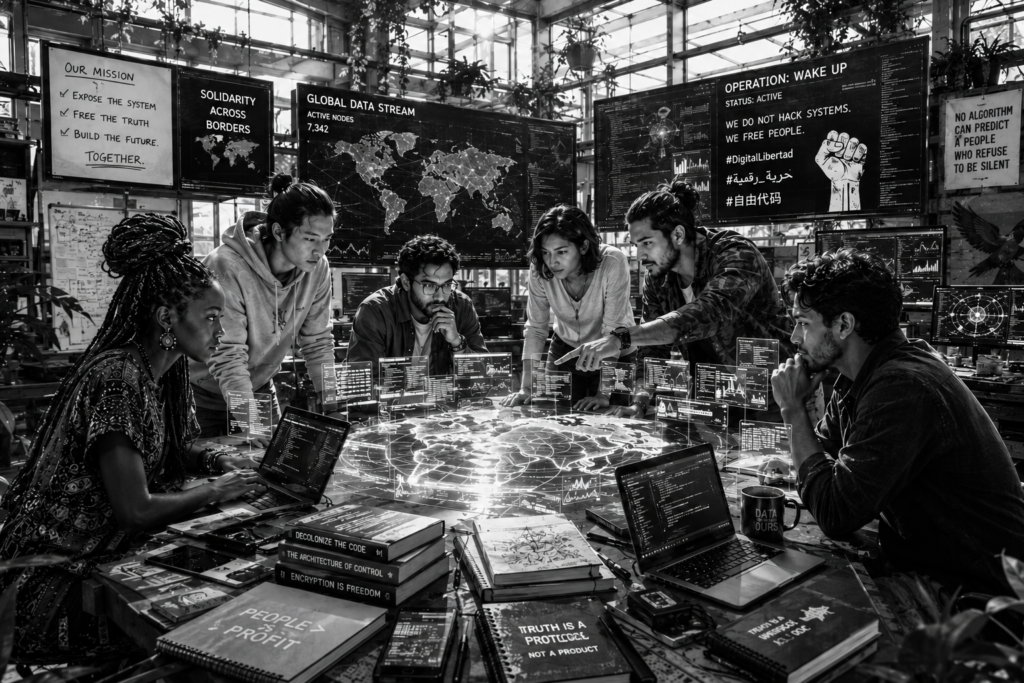
The first of them called herself Invader001 but her name was Basira. She had been a hacker since she was fourteen, and conducted a quiet private practice of exposing electoral fraud in three West African states. She was, among the Invaders, the least ideological. She was also, as it turned out, the most dangerous, because she was the most interested in what was true.
Basira discovered the Quiet Layer eighteen months after Fraser had. She did not go to a solicitor. She went to a chat room. The chat room, which had been set up by a Venezuelan coder called Mateo Sánchez – Invader 003. That chat room was the meeting place of a loose alliance of five people who had decided that they no longer believed the official account of Dev.
The known members of the Invaders are worth naming. Mateo; Aisha al-Farsi (Invader 004); Kaito Nakamura (Invader 005); Amara Diop (Invader 006); and Aamir al-Hakim (Invader 002).
What the Strings Pulled In
Driven by the need to fight the system, they made it their personal mission to pull down corrupt governments and corporations. What they didn’t know was that their passion project – Negasi’s dream, had turned out to be the biggest and most powerful corporation while they fought all those who would have been his competition.
What they found, over the course of eighteen months and three hundred and fifty million lines of audited code, was several mechanisms embedded in the system. The ones that could be named were, in the order of their discovery:
First, the Quiet Layer itself, exactly as Fraser had described it. Second, a routine that the engineers referred to internally as the Dark Web Invasion, which was not a hack, as the public later mistook it for, but a diagnostic — a means by which The Hounds could enter and modify the Stems of individual Dev residents without leaving a trace. Third, a set of facilities — physical facilities, on Earth — whose purpose was not transition but the ongoing feeding of the substrate. These facilities were later referred to, in the report the Invaders submitted as Body Farms and Back Doors.
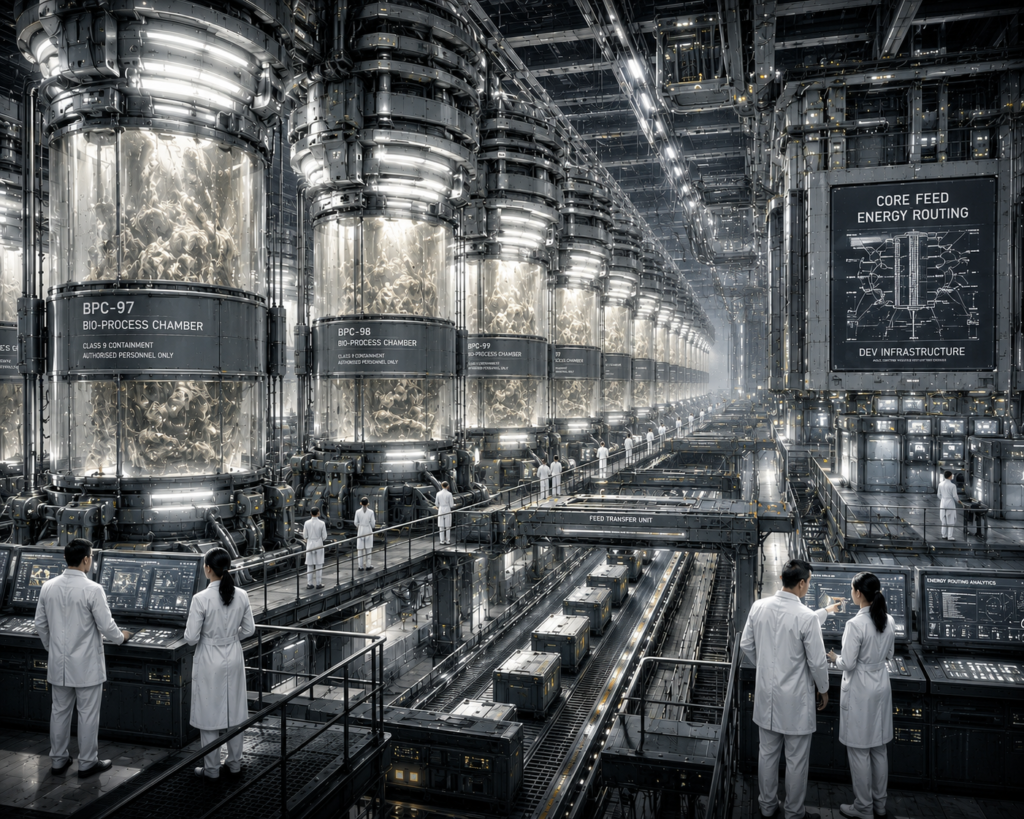
The body farms are the part of the chronicle that the delegates will have read about in the briefing materials. The most important discovery from that report was the fact that the substrate required energy called seed matter. The seed matter was biological. It had, in the early decades, been animal. It had, by the middle of the eighties, become human.
The human seed matter came from two sources. One was post-transition remains — the bodies people leave behind, which are not discarded but processed. The other source is the one the Council should hold in its mind tonight. It was death-row inmates, in countries where the death penalty is legal. Their bodies were purchased under agreements that had not been made public. The agreements had been renewed, quietly, every four years since 2061.
Operation DeCODE
The Invaders did not, in the end, take Dev apart. They could not. They had discovered, too late, that the system had been built to survive exactly the attack they were best qualified to mount. What they did instead is described in the dossier we know now as Operation DeCODE.
I wouldn’t go into detail, for time’s sake, but I would remind this Council that the actions of the people closest to Negasi is a message to us. They had considered everything they helped build and decided it was better for humanity to have it dismantled. Operation DeCODE was a plan to smuggle a parallel encrypted stack of memory into the Librarians’ archive. The parallel stack would contain the evidence the Invaders had gathered. If any of them were killed or disabled, the stack would be released, automatically, to the global press. It was an insurance policy. It was also an accusation, pre-written.
Aamir al-Hakim was the one who disappeared first. He went dark on a Thursday afternoon in March 2087. His last message to the group was a single line: I think they know. He did not arrive at the rendezvous. His stem was never recovered. The group assumed, and I believe they assumed correctly, that he had been ‘corrected’.
The other five proceeded. They did not complete the operation. They completed enough of it. The evidence began to leak, in pieces, across the spring and summer of 2087. The System did not name the source or deny the contents.
The Silent Rebellion
What the Invaders discovered about themselves, in the process, is the hardest part of their chronicle to read. It is set out in the narrative later filed as The Silent Rebellion.
They could have published everything. They did not. They decided, collectively, that exposing the full truth would cause a collapse that could not be managed. Dev had by that point become, for most of the world’s population, humanity’s last plausible shelter. They could not, in conscience, light the shelter on fire.
I mention this because the delegates will have heard the Invaders described, in some circles, as heroes, and in others as meddlers, and in still others as traitors. They were different things at different times, but it seems they tried to stay true to their consciences. As adults who had discovered that the world was governed by a shadow council, they tried to unseat the council without destroying the world. None of them could be here to tell us what motivated their actions because they are all dead.
PHASE SEVEN
In which bodies begin to be found, an artist regrets his song, and the argument for and against Development is conducted on a stage the world was not quite ready for.
The Disappearances and the Debate (2086 – 2090)
The Seven
The investigation that led to this vote started with the disappearance of seven men.
Between January and March of 2086, seven prominent Nigerian politicians disappeared. They had no common enemies. They had no common friends. Samuel Dennayer, an investigative journalist, called them The Disappearances. The only connection was that these men all had access to public funds. The first was a former Governor of a south-western state. The seventh was a former chair of the national petroleum corporation. The families went to the police. The police went nowhere. Then, in April, the first body was returned. It was found in a disused abattoir in the outskirts of Cape Town. Its only ornament was a small piece of paper, folded twice and stuffed in the victim’s mouth. The paper bore two pairs of initials: F.S; B.B.
A second body was recovered, a fortnight later, in a courtyard in Medellín. The same two pairs of initials. Then Lagos, then Abuja. The meaning of the initials remains speculative to this day.
The last body to be returned belonged to Itumeleng Tsotetsi, a former member of the South African cabinet. His death brought the streak of deaths to the attention of the global press. The System was more than able to track everything on Dev, but it was not equipped to cater to issues on Earth. This was also the first time The System faced deep accusations from Earth’s remaining population. It simply denied any involvement. But it would not be the last time we suspected the System of silencing people to send a message.
Kytz
The musician called Kytz had, by 2088, been silent for almost a year. He had been the voice of the Dev Campaign. His reimagining of John Lennon’s ‘Imagine’, had been the signature piece of the launch in 2078.
Kytz’s involvement in the public acceptance of Dev, his change of heart, and his sudden disappearance had caused more than just a stir. The record in The Disappearance of Kytz offers more for us to consider. All those who got close to Negasi somehow found fault with his ambitious project at the end of the day.
Kytz had planned to reveal all what he had found in a new project he was working on but he did not finish it. He disappeared in the spring of 2088. Unlike the politicians, his body was not returned.
The Big Debate, and the Great Debate
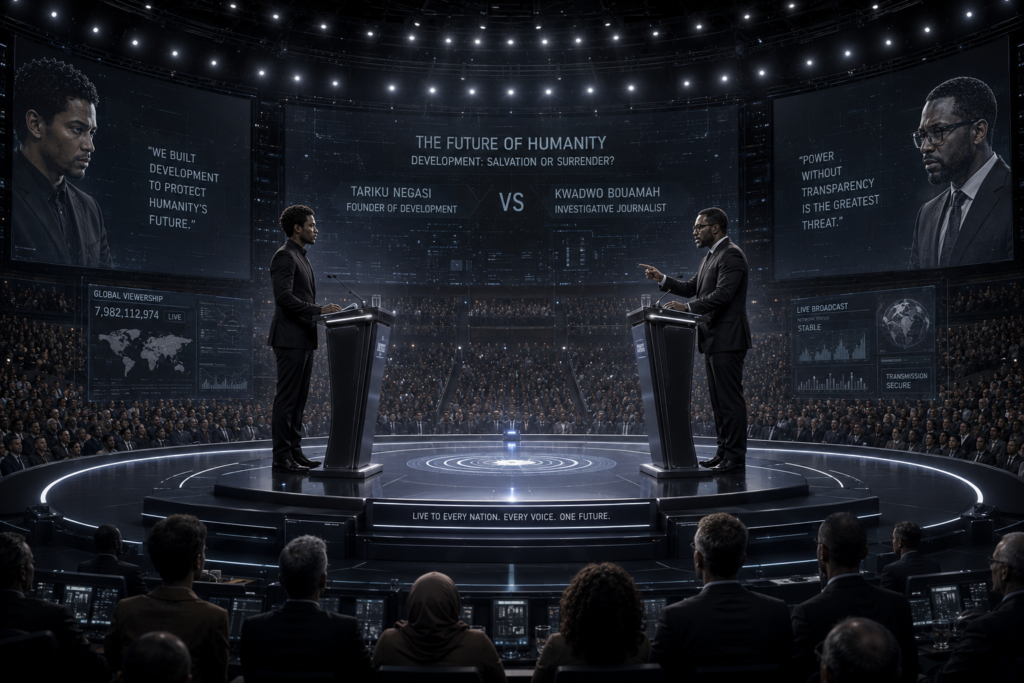
There were two debates. The first, in July of 2087, is the one that was broadcast from a stage in New Lagos and that is preserved, in the global archives, as The Big Debate. It was between Negasi and me.
I have spoken about it enough in my career that I will only refer to parts of it that may have been misunderstood. I was there because Negasi had asked specifically for an Earth-Side journalist who would not flinch.
I argued that Dev had become an ambition that had consumed him with power. The idea of taking action for people to save them still requires consent. He argued that people made the decision – nobody was forced. At that time, people did not fully understand what they signed up for. That grey area is the monster that consumed most of them. Neither of us persuaded the other. Neither of us, I believe, persuaded anyone who had not already decided. It was the kind of debate that history remembers for being watched, not for being won.
The second debate was in May of 2089. The Great Debate was not between persons. It was a seven-day global deliberation. The outcome of that was a report which is also the reason why we are here tonight. The question it asked, and did not resolve, was the question the Chair has just put to this chamber.
RETURN TO THE CHAMBER
The Second Vote
(Zurich 2091)
What Aremu Said
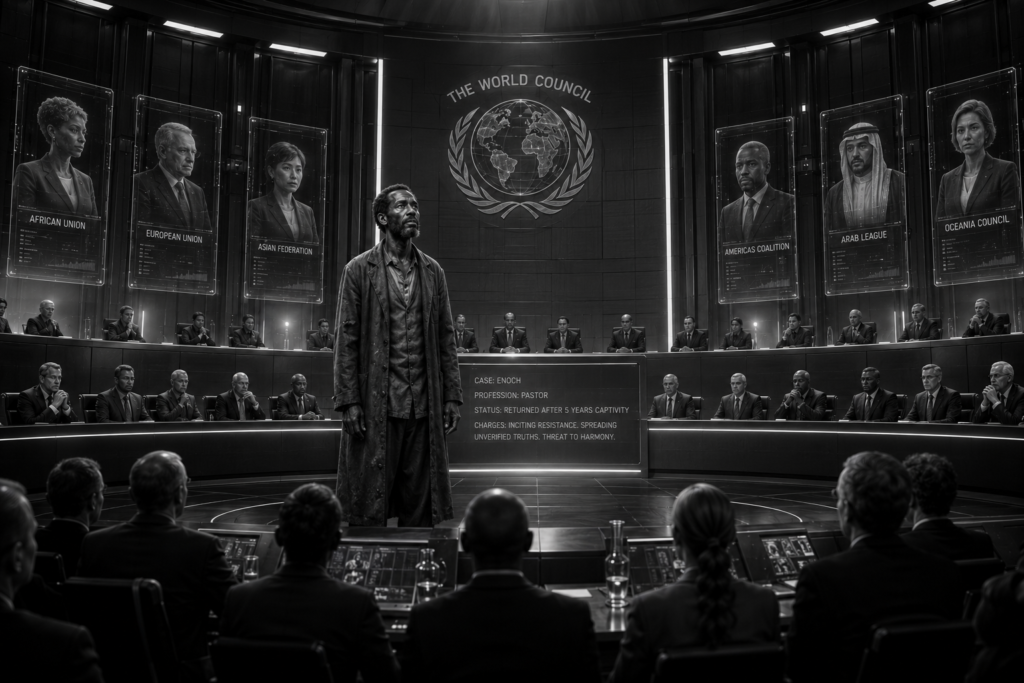
I have been speaking for about three hours. We are all tired, except the delegates from Dev.
Before I conclude, the Chair has asked Pastor Joshua Aremu to address the Council.
Aremu stood. He was thinner than he had been in his photographs, and his voice, when it came, was not the voice of the orator from the New Life Assembly pulpit. It was the voice of a man who had spent five years in a room that he would not, even now, describe.
“I did not transition,” he says. “I did not die. I was taken. I was held in a facility that someone in this room knows about. I want you to know that while we are here, there people still held against their will, in that place.
In summary, I was abducted because I had received a message and I was going to release it. Today, with all I have heard here, it wouldn’t be a revelation. We have slowly accepted all those things. Now we are even considering a vote, because we have accommodated all the atrocities one by one. Five years ago, I was told that the message would cause a lot of trouble. They said they would manage the trouble if it leaked, but that the management would include me.
He did not raise his voice. He was, I suspected, incapable of raising it then.
“I don’t know why I was let go. Maybe I was meant to be a distraction, but I gained my freedom three weeks ago. There’s little more to say after the lengthy chronicle from Kwadwo Bouamah. The thing I wish to say is short. The facility exists. It is not an accusation. It is a building that I was kept in for five years. I trust the Council and the world’s press to find it and shut it down.”
He sits. He does not look at Negasi. Negasi does not look at him. It is the stillest moment I have known in a public chamber.
What Adaeze Said
Adaeze Obi spoke next, on behalf of Right Place International. She did not read from notes. She carried, instead, a small wooden box, which she placed on the table in front of her. She did not open it.
“We are,” she says, “the people who stayed. We are not heroic. We are not virtuous. We are, in many cases, only stubborn, or poor, or afraid of the machine in ways we cannot articulate, or bound by the sort of responsibility that does not survive a transition. We run clinics. We run schools. We keep the archives of the languages that the Wave has thinned. We are on every continent. We have, at present, six million registered volunteers and perhaps forty million who call themselves members without registering. We have buried, I would estimate, three hundred thousand people whom the families could not afford to bury, and we have found homes for, I would estimate, twice that many children whom the Wave left behind.”
She placed one hand on the wooden box. She did not open it.
“I have not come to read the Council a list. I have come to show us what we chose. The Wave of Desertion has been described by the advocates of Dev as a liberation. It felt more like an abandonment. Children left behind, elderly people forgotten in homes, and more. The children are being raised by the elders. The elders are being ‘raised’ by strangers. That is not a paradise. That is a settlement, fighting for survival.”
She picked up the wooden box and, at last, opened it. It contained a single notebook. It is not hers. It is, she says, Pastor Aremu’s. It had been given to Right Place International three weeks earlier, at the crossroads outside Jos. It has been authenticated. It will be entered into the Council record. It is not necessary, she says, to read from it tonight. She only wishes the Council to know that it exists.
What Negasi Said
Finally, Negasi was given the floor. He rose slightly in the chair to acknowledge protocol before proceeding without drama.
“Madam Chair,” he said. “Delegates. I will not be long.”
“I have listened, tonight, to a chronicle that was, in most respects, accurate. A lot has been said, but this is not a courtroom, and I do not stand accused. So I will speak, in the hope that your decision has not already been made based on Bouamah’s lengthy submission.”
“I did not build Dev to liberate anyone. I built it because the planet was failing and because I did not believe that the planet could be saved by the people who were failing it. I built Dev as a solution to our most critical challenges – as I understood then.”
“In building technology for humans, one can never fully grasp all that humans want, would desire, and how they will use or manipulate it. This has been the biggest challenge for us. We were forced to make hard decisions – the kind that this Council, and the one before it, would be well aware of. Delegates who have read the record of the Great Debate will know which decisions I am referring to. I do not regret most of these decisions, even though I regret some of their consequences.”
“The question before this Council is whether the thing I built should continue. I do not believe the question is mine to answer. This Council will decide and we will abide by the vote. I have not, despite what has been written of me, ever been a king or tried to rule anyone other than myself. I have been, at most, a man who could see what was coming and had the courage to decide for myself. My decision to make this shelter available to others has been my only mistake.”
I took on this task, like a father who protects his child, even when the child cannot see the danger. I erased differences, gave mankind a solution to mortality, erased death due to disease and disasters. I gave people life, ability, expression and most of all, even though quite unintentionally, freedom.”
“I created an alternate system for the world, without asking anyone to abandon what they already had. Somehow, in all this, I have become a villain. The testimonies I have heard, even here tonight, have left the issue of Dev and focused on me and what the consequences of other people’s use and abuse of my creation. The tool is rarely the problem. The abuse of it, is. I would like this Council to remember that the decision tonight is about the continuation of the tool. We can discuss the alleged abuse later.”
“I will add one thing. Pastor Aremu has spoken of a facility. I have never been there and I was not aware, until tonight, of some of the activities he has alluded to. I give you my word, that I will find out who authorized those actions and address them appropriately.”
He leaned back in his seat and looked forward, not meeting any gaze. There were murmurs that grew into a constant hum in the room.
The Chair
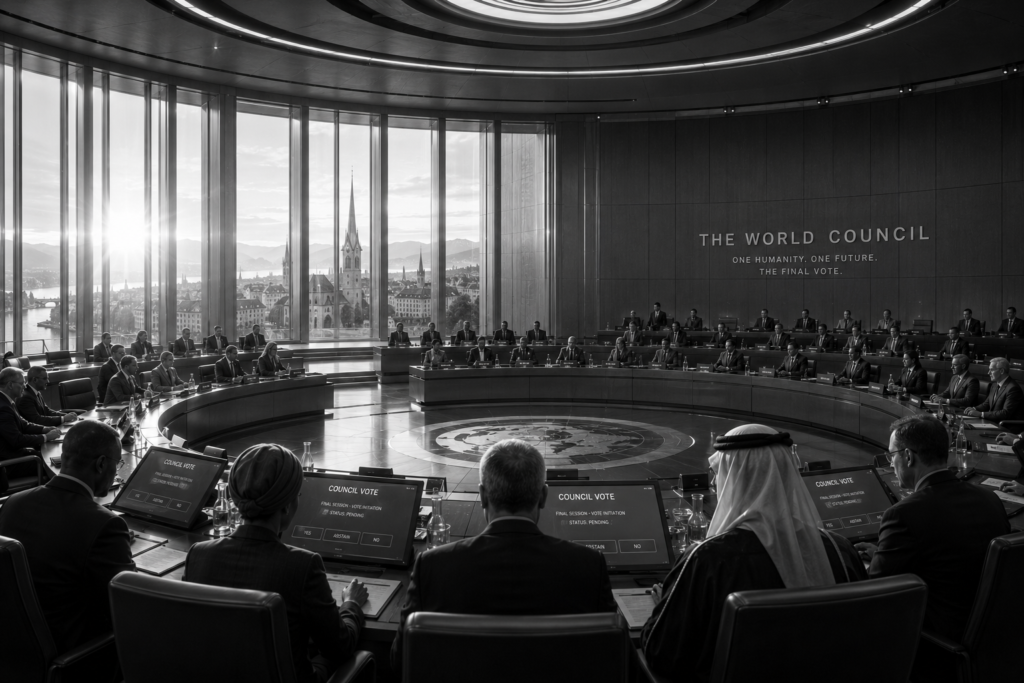
The Chair got up and placed her hand on the lectern, bringing the room to silence again.
“The Council will adjourn for the tabling of the motion. The vote will be taken at nine in the morning, local time. Tonight’s record will be entered, with the notebook submitted by Right Place International and all testimonies, into the archives of The System and, by the treaty of 2077, made available, unredacted, to any member of the public who requests it.”
“The question is not a question The System can properly answer alone. It is a question every human being, wherever they are — on Earth, in Dev, between — is entitled to put to themselves, and to answer in private, and to make count.”
She looked, briefly, at me. Then at the galleries. Then at the room.
“Those of you who are moved to make that answer count,” she says, “will find that the means of doing so have been arranged.”
And she sat.
EPILOGUE
To the Reader
I have been asked, by the editors of this volume, to say a few words to you directly before I present the voting mechanism.
I have tried not to influence your decision, but to state the facts as I understand them.
The Council votes at nine in the morning, and the number it produces will be recorded as the result of the first vote. The Council’s vote alone will not answer the question about the existence of Development.
The question will be settled by the answer that each of you gives to it, in a place you will not share with anyone. That record will exist only in this place and will not be recorded, even in the stacks of the Librarians.
The editors have arranged that you may make your answer known, if you wish, in the place where this chronicle is kept. You will find, at the end of the volume, two options for you to make just one choice. You may also choose to opt out of the vote. That, in my opinion, is the most honest answer a person of my generation can give.
As for my personal decision? I will wait until morning.
— Kwadwo Bouamah, Zurich, the night before the Second Vote
A NOTE FROM THE EDITORS
The chronicle above is, and was always intended to be, incomplete. The stories it draws from are published, in their original form, in the companion volumes of The Time Tales anthology. Readers who wish to read the sources may do so through the archive — the links will soon be made live. In the interim, the story titles in this volume are marked by underline, without hyperlink, so that the reader may return to them when the record is opened.
The reader will find, in the archive, the option to register a view — for, or against, the continuation of Development — before the Council’s own result is announced. The editors have set the two options at the end of the volume for precisely this purpose. Readers are invited to choose either, or neither, and to remember, as they choose, that a decision to note choose is also a choice.
— The Editors, Time Tales Anthology, 2091
THE TWO OPTIONS
At the close of this volume, you are invited — not required — to register your own answer to the question now before the General Council of The System.
OPTION ONE — FOR THE CONTINUATION OF DEVELOPMENT
To affirm, with the sixty-eight per cent of New Delhi, that the substrate should continue, and that its troubles are the troubles of an imperfect technology rather than a wrong one.
OPTION TWO — AGAINST THE CONTINUATION OF DEVELOPMENT
To affirm, with the thirty-two per cent of New Delhi and the witness of Pastor Aremu, that the substrate has produced a harm that the substrate cannot undo, and that the continuation of Dev must end.
The choice is yours.
The tally will be published, alongside the Council’s, at the conclusion of the 2091 session.
— End of Volume —