
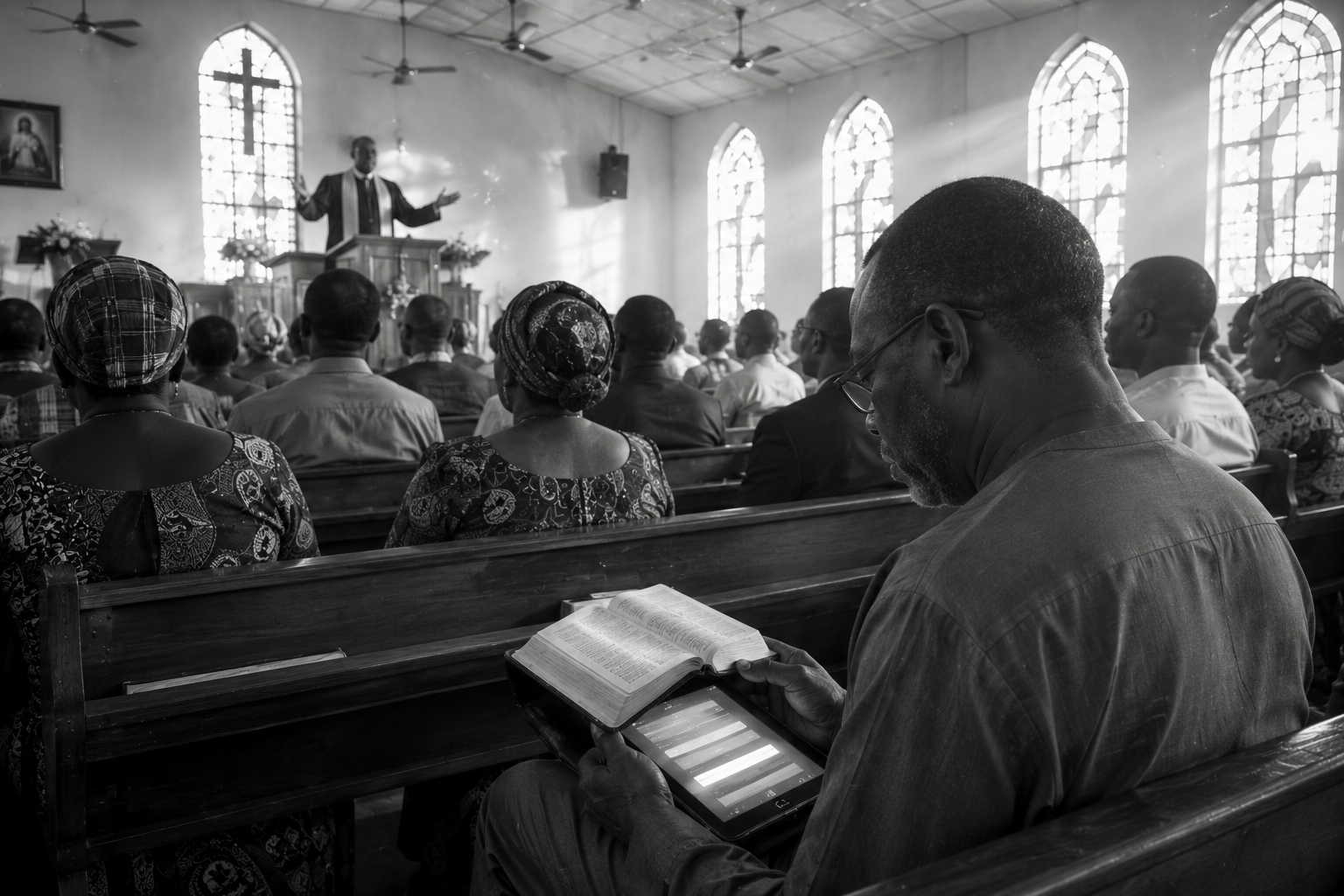
By Pastor Joshua Aremu — New Life Assembly, Lagos, 2081
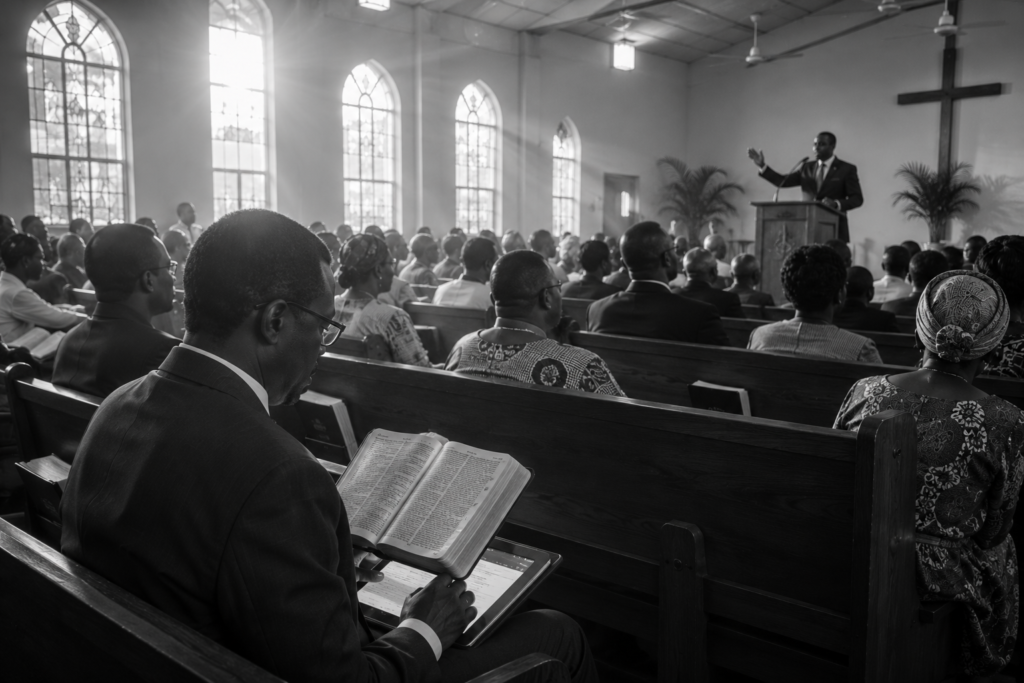
The day my favourite deacon disappeared, I was preaching about Elijah under the juniper tree.
I remember the irony of it now. I was at the pulpit saying how the prophet asked God to take his life because he was “not better than his fathers,” and somewhere in the fourth row, someone was sitting with his phone under the Bible, filling out a form to be taken to a higher life. He had already decided. He was already halfway gone.
The form was the MaDe Pre-Transition Application, and he wasn’t alone. There were many who had decided and where just waiting to hear back from the transition facility. It felt like the typical African, waiting for a visa. The difference was that time was the only barrier, unlike the untold horrors of the visa application process of the past.
I want to be very precise about what happened next, because I have watched too many pastors turn this story into a sermon about the end times. That cheapens it. What happened was not prophecy or anything predicted in the Bible. It was sociology and humanity, looking for a shortcut to eternity.
This exodus started at The New Delhi Summit. It was broadcast on every screen. I watched it in my office on a monitor borrowed from the church secretary. I went home that night and my wife, Bisi, was already on her laptop looking at transition packages. She barely noticed when I walked in, until I drew her attention with a quesiton.
“How much?” I asked.
She looked up without embarrassment. “The premium sleeve is one hundred and forty thousand dollars.”
“And the economy sleeve?”
She paused. “Twenty-two thousand.”
I sat down.
“Twenty-two thousand,” I repeated. “And after that?”
“After that, you’re there. Forever.”
The excitement in her voice settled it. I had heard that excitement before and I couldn’t convince her otherwise the first time. She had picked a wedding venue that was beyond our budget and she wasn’t going to budge. I knew it was just a matter of time before Bisi would find herself in Dev.
I stared at the ceiling for a long time. We had more than twenty-two thousand dollars in savings. However, it had taken us eleven years to save it, through school fees and hospital bills and the thousand small emergencies of the normal Lagos life. Twenty-two thousand dollars was almost our entire margin against disaster.
“We are not going,” I said – trying to convince myself more than Bisi.
Bisi said nothing. She closed the laptop slowly, pushed it to the coffee table and turned to sleep, backing me, like what I had just said would not be entertained or considered.
When the exodus kicked in, it started in trickles. The rich left first. That part every history book gets right. What they don’t tell you is the texture of it; how it didn’t happen all at once, dramatically, like a flood. It happened the way water seeps under a door.
The politicians were unable to pick between going to a blissful life on Dev and trying to own everything on Earth. The first one to openly accept the transition was our Governor. He held a press conference from his transition chamber. The MaDe pod was white and pod-shaped, like a monstrous egg. They lit it with blue lights for the cameras. He stepped in. He dissolved.

The stream cut to applause.
The stream cut to the deputy who had been preparing to take over from the Governor two weeks ago — He was looking at the pod as if he expected the governor to step back out. He didn’t.
That was when I understood what we were dealing with. Not migration. Abdication.
The Wave — as they called it — had already taken effect. African leaders were just late to the party.
I watched from my church window as people started to give out propoerty. There was no need to try to sell them, Nobody needed money in Dev, from across the street loaded things into a danfo. But she wasn’t going north or south. She was going to the transition centre on Allen Avenue. She was going with three suitcases — which struck me as strange. What do you pack when you’re leaving your body behind? The bags were mostly for her children, who were already on Dev and could not collect the things she wanted to bring them. She said she was carrying “memories.” Printed photographs. Her late husband’s tie collection. Things she wanted to reconstruct on the other side.
“Mama Titi,” I called from across the fence.
She looked up, and her face did that thing I had started to see everywhere — the slight embarrassment of someone who has made a choice they know you won’t approve of. Like catching your pastor’s eye as you leave a church you’ve decided to stop attending.
“Pastor,” she said. “I was going to come tell you.”
“Come and sit down first.”
She sat in my parlour for forty minutes. She told me about her son Gbenga, who had gone to Dev two years earlier and was “doing well.” She pulled out her phone and showed me a photograph — a screenshot of a video call. Gbenga looked healthy, happy, fuller in the face. She told me Dev was warm. That on Dev you didn’t feel hungry. That the pain she had been managing in her hip for six years would simply be gone.
“Gone how?” I asked.
“Just gone. No pain. No nothing.”
I thought of the scripture: He will wipe every tear from their eyes. There will be no more death or mourning or crying or pain, for the old order of things has passed away.
I thought of it and then I thought of Negasi in his white agbada, managing his smile.
“What happens to your shop?” I asked.
“My nephew will run it.”
“And your property?”
“The church can have the land. Write it down, Pastor. I’m signing it.”
I didn’t know whether to thank her or weep. I thanked her. Then she left. Then I wept.
By 2079, my church had lost sixty percent of its congregation.
I am not using that number rhetorically. I kept records. At peak — and our peak was the Christmas service of 2077, after the New Delhi Summit, when everyone came to pray about what they had seen — we had four hundred and twelve registered members. By Easter of 2079, we had one hundred and sixty-three. By the end of that year, we had ninety-one.
The ones who remained were mostly elderly, mostly poor, and almost entirely certain they were living through the end of the world.
On this last point, I began to think they were not wrong.
But the end of the world is not what I had been preaching. I had been preaching fire and antichrist and the mark of the beast — the sermons came out of me almost automatically, like muscle memory. I had been training for this moment my whole ministry. But standing in front of ninety-one people who were frightened and hungry and watching their families dissolve into blue light, I began to feel the sermons were a kind of failure. Not false, exactly. But insufficient.
What do you say to Sister Ngozi, whose three children are on Dev and who calls them on a screen every Sunday, and who sometimes cries in the third pew not because she misses them but because they seem happy and she doesn’t know what to do with that?
What do you say to old Alhaji Musa who converted twenty years ago and who tells me he is not afraid of dying but is afraid of dying and finding out Dev was heaven all along, and that he waited here too long?
I said the things I knew to say. I said God is not a digital product. I said consciousness is not a soul. I said the body is not a prison. I said these things with conviction, because I believe them.
But I also started to wonder, for the first time in my ministry, whether conviction and truth are always the same thing.
In 2080, the government, or what was left of it, stopped collecting property taxes.
There was no announcement. The system simply stopped sending notices. You’d pay and it would bounce. This is how you knew the administrative class had gone. The tax system is one of the last things a government lets go of. When that goes, the skeleton has already left the building.
Lagos descended into a kind of quiet chaos that I can only describe as dignified disorder. People were not rioting. People were farming. In the medians of Ozumba Mbadiwe, where the big SUVs used to sit in traffic for two hours, people had planted cassava, yam and more. In Balogun market, the stalls that used to sell electronics now sold seedlings, lamps and other things needed for survival. There was a barter economy in our street — two cups of garri for one sachet of kerosene, four mangoes for a battery, an afternoon of carpentry for a meal.
It sounds romantic, written down. It was not romantic. It was exhausting, and sometimes terrifying, and often beautiful, in the way that things stripped to their bones can be beautiful.
The young men who stayed were the most surprising part of all this.
I had expected the young to leave fastest. They had the least to lose. They had been raised on the internet, on the fantasy of elsewhere. Every generation before them had dreamed of Japa — of escape, of abroad. Dev was the ultimate abroad. You could not be denied a visa. You could not be deported. I expected them to queue at the transition centres the way their parents had queued at the embassy.
Some did. But many didn’t.
A boy named Seun — he couldn’t have been more than twenty-two — knocked on my door one afternoon and said he wanted to help with the community farm. He had tattoos on his neck and wore his jeans lower than God intended, and I had once asked him to leave my church for disrupting a service. He was now offering to dig.
“Why are you still here?” I asked him. Not unkindly. Genuinely.
He thought about it for a while, looked down and then up at my face.
“Because,” he finally said, “on Dev you can be anything. Here, I can become something. The one I can touch and feel is the one I want to chase.”
I let him dig.
The wave did not end. It slowed to a tide, and the tide still pulls.
As of this writing, four years after the Summit, from the same church office where I have been writing for thirty years, we have seventy-three members. The community farm feeds about three hundred people. The school we opened in the old primary has sixty-one students. Seun runs the maintenance crew for the solar panels we salvaged from abandoned Ikoyi mansions.
My wife Bisi is still with me. She never went. But sometimes I catch her watching the clouds like Dev is up there, and I know she is still considering her choice. Every day she stays is a choice.
I do not know what is on the other side of that door. I have spent my life insisting I do, and I am no longer willing to continue that particular performance.
What I know is this: there is something left here. Something the transition forms cannot process. It is not better or worse than what Negasi is offering. It is just ours. Untranslatable. Irreducible.
I do not know what to call it, except human.
And on most days, not all days, but most, that is enough.
[EDITOR’S NOTE: Pastor Joshua Aremu continued writing the “Rubble Reports” — a weekly letter distributed through a network of remaining Earth communities — until 2086, when he disappeared from Lagos. No transition record was found in MaDe’s database. His congregation believes he was taken. His daughter believes he went quietly, on his own terms, when no one was looking.]